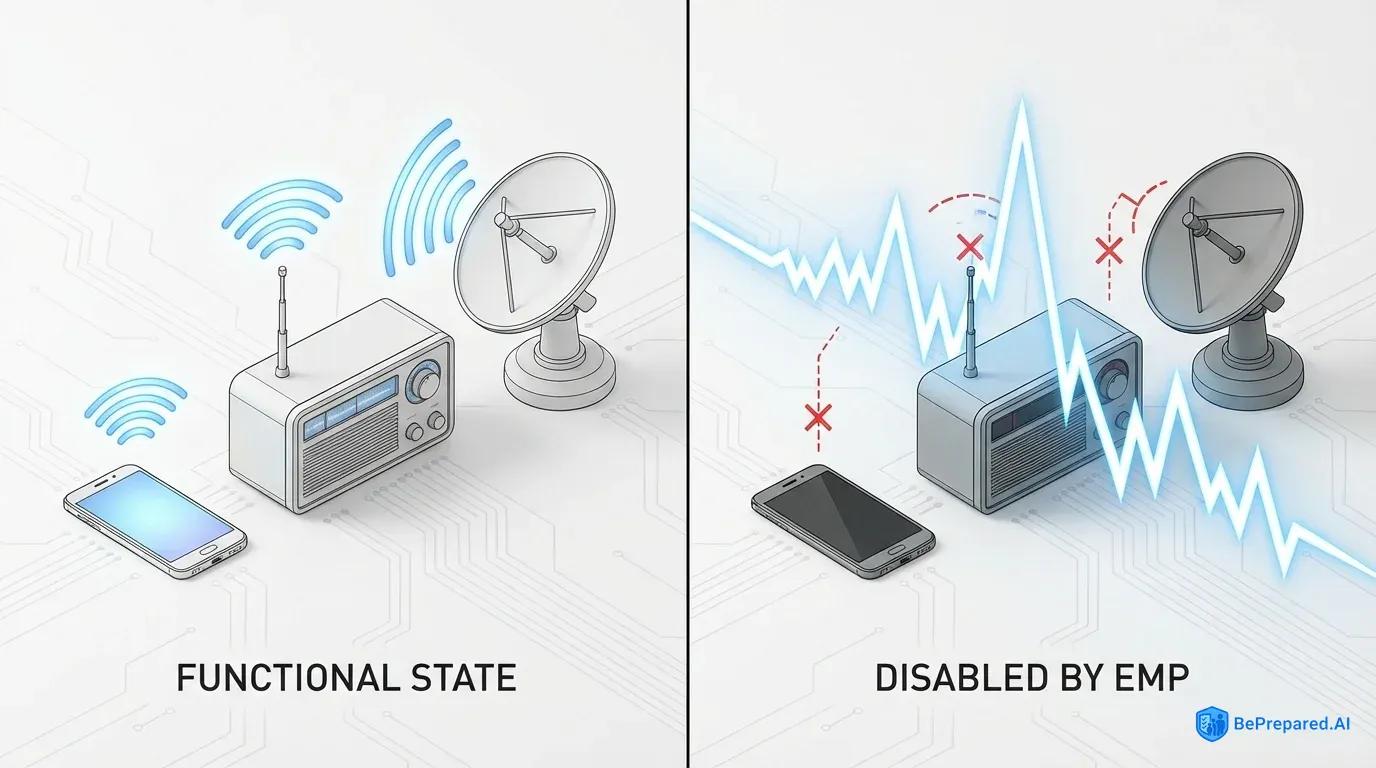
Understanding EMP Threats to Communications
The power grid flickers, then dies. Within microseconds, your smartphone becomes an expensive paperweight, your radio falls silent, and the constant hum of modern connectivity vanishes. This isn't science fiction—it's the reality of an electromagnetic pulse event. Understanding how it threatens your ability to communicate could mean the difference between coordinated survival and dangerous isolation.
An electromagnetic pulse, or EMP, represents one of the most comprehensive threats to modern communication infrastructure. At its core, an EMP is a burst of electromagnetic radiation that induces powerful electrical currents in conductive materials. These currents can overwhelm and permanently damage the delicate electronic components that our communication systems depend upon. The Department of Homeland Security has identified EMP events as a critical infrastructure threat, noting that an EMP can disable electronic communications across geographic areas spanning hundreds or even thousands of miles .
EMPs fall into two primary categories, each presenting distinct challenges for communication resilience. Natural EMPs originate from solar activity, specifically coronal mass ejections that hurl charged particles toward Earth. When these particles interact with our planet's magnetic field, they create geomagnetic storms capable of inducing currents in long conductors like power lines and communication cables. The 1859 Carrington Event demonstrated this power when telegraph systems worldwide sparked and caught fire, with some operators reporting they could send messages using only the induced current from the solar storm itself. In our far more electronically dependent age, a similar event would prove catastrophic.
Man-made EMPs result from nuclear detonations at high altitude or from specialized non-nuclear EMP weapons. A nuclear EMP occurs in three distinct phases: E1, E2, and E3. The E1 pulse arrives first, lasting mere nanoseconds but generating extremely high field strengths—more than enough to destroy semiconductor junctions in unprotected electronics. The E2 pulse resembles lightning and follows immediately after, while the E3 pulse mimics natural geomagnetic storms but with compressed timeframes. According to the Department of Energy's EMP Resilience Action Plan, a single high-altitude nuclear detonation over the central United States could affect the entire continental landmass .
Your communication devices vary dramatically in their vulnerability to EMP effects. Modern smartphones, tablets, and computers contain millions of microscopic transistors operating at low voltages—the E1 pulse can destroy these components instantly. Traditional landline phones connected to the legacy telephone network show more resilience, particularly older mechanical switching systems, though the infrastructure supporting them remains vulnerable. Amateur radio equipment presents a mixed picture: older vacuum tube technology demonstrates remarkable EMP resistance, while modern solid-state transceivers share the same vulnerabilities as other contemporary electronics. The longer the antenna or cable connected to a device, the more energy it can collect from an EMP, functioning essentially as an unintentional receiver for the destructive pulse.
The Department of Homeland Security emphasizes that different EMP types create varying disruption levels . A localized non-nuclear EMP weapon might affect a single building or city block, while a high-altitude nuclear EMP could render electronics inoperable across an entire continent. This spectrum of potential impacts demands equally varied protective approaches, from individual device protection to community-wide infrastructure hardening.
- Fiber Optic Networks
- Highly EMP-resistant due to non-metallic construction; minimal signal degradation; requires powered terminals
- Satellite Communications
- Extremely vulnerable to EMP; orbital systems and ground stations at high risk; widespread coverage area affected
- Hardline Telephone
- Medium vulnerability; copper lines susceptible but basic functionality may persist; mechanical switches most resilient
- Cellular Networks
- Highly vulnerable; extensive electronic infrastructure; cell towers and switching stations easily damaged
- High Frequency Radio
- Low-moderate vulnerability; simple systems more resilient; long-range capability; antenna systems at risk
EMP-Resistant Communication Methods
When conventional electronics fail, the communication systems that survive will share a common characteristic: they either avoid vulnerable electronic components entirely or employ technologies inherently resistant to electromagnetic interference. Understanding these alternatives transforms EMP preparedness from an abstract concern into practical capability.
Fiber optic communication systems stand as one of the most EMP-resistant technologies in modern use. Unlike copper cables that conduct the electrical currents induced by an EMP, fiber optic lines transmit data as pulses of light through glass or plastic strands. These non-conductive pathways remain unaffected by electromagnetic radiation. Fiber optic lines are inherently immune to direct EMP effects . The electronics at each end of a fiber optic connection—the transmitters, receivers, and routers—certainly remain vulnerable, but the transmission medium itself survives intact. This characteristic makes fiber optics invaluable for critical infrastructure, and the IEEE has documented numerous installations where fiber optic systems provide EMP-resilient backbones for emergency communications networks .
The practical implications for preparedness-minded individuals are significant. While you probably won't install your own fiber optic network, understanding that certain communication infrastructure possesses inherent EMP resistance helps you plan around which systems might remain operational. Government facilities, military installations, and critical infrastructure increasingly rely on fiber optics specifically for this resilience. In a post-EMP scenario, these systems represent potential communication nodes if you can reach them or if they maintain public emergency services.
Hardened radio equipment offers another avenue for EMP-resistant communications, though "hardened" encompasses a range of protective measures. Military-grade communications equipment undergoes extensive EMP hardening during manufacture, incorporating shielding, filtering, and component selection designed to survive the harsh electromagnetic environment of a nuclear battlefield. The EMP Task Force on National and Homeland Security notes that properly hardened radio systems can maintain functionality even when exposed to field strengths that would destroy commercial electronics . However, truly hardened equipment carries military-grade price tags and often requires special licensing or authorization for civilian use.
A more accessible approach involves older radio technology that predates vulnerable solid-state components. Vacuum tube radios demonstrate remarkable EMP resistance. The robust construction of vacuum tubes, operating at higher voltages and lacking the microscopic junctions that make transistors vulnerable, allows them to survive electromagnetic pulses that would destroy their modern equivalents. Amateur radio operators have long recognized this advantage, with many maintaining tube-based transmitters specifically for emergency backup. These vintage systems require more power, generate more heat, and demand more maintenance than contemporary radios, but they offer a functional trade-off between convenience and resilience.
Pros of Vacuum Tube Technology:
- Survives EMP events that destroy solid-state equipment
- Repairable with basic tools and replacement tubes
- Proven reliability over decades of use
- No dependency on modern supply chains
Cons of Vacuum Tube Technology:
- Higher power consumption than modern radios
- Larger and heavier than contemporary equipment
- Requires warm-up time before operation
- Replacement tubes becoming harder to source
Non-electronic backup systems represent the ultimate in EMP resistance because they eliminate electronics entirely. Mechanical semaphore systems, signal flags, mirrors for heliograph communication, and even trained messenger pigeons have served humanity for millennia and remain completely immune to electromagnetic effects. While these methods seem primitive compared to instant digital messaging, they provide guaranteed communication capability when nothing else works. The comparison between electronic and non-electronic systems isn't about which is "better" in absolute terms—it's about which remains functional under specific threat conditions.
Consider the practical comparison: a modern encrypted digital radio system offers secure, instant communication across hundreds of miles with crystal-clear audio quality, but a single EMP can render it permanently inoperable. A set of signal flags provides communication across only visual distances with limited information bandwidth, but no electromagnetic pulse can damage them. The wise communicator doesn't choose between these systems—they maintain both, understanding that different scenarios demand different tools.
This redundancy through diversity forms the foundation of resilient communication planning. When one system fails, alternatives remain available. Your communication toolkit should span the spectrum from high-tech to no-tech, from long-range to local, from complex to simple. Each method fills a specific role, and together they create overlapping layers of capability that can withstand multiple simultaneous failures.
[Download our EMP Communications Protection Checklist—a comprehensive guide covering equipment selection, storage protocols, and testing procedures to keep your communications operational when everything else fails.]
Protecting Your Communications Equipment
Sarah learned about Faraday cages from a YouTube video and figured she'd protect her emergency radio by wrapping it in aluminum foil and tossing it in a metal trash can. When she tested her setup with an RF meter, she discovered her "Faraday cage" was about as protective as a screen door on a submarine. Proper EMP protection requires understanding the physics involved and implementing multiple layers of defense with precision and care.
A Faraday cage functions by distributing electromagnetic charges around its exterior, preventing them from reaching the interior space. For this protection to work, the cage must form a continuous conductive enclosure without gaps larger than the wavelength of the radiation you're blocking. The E1 pulse from a nuclear EMP contains high-frequency components, requiring careful attention to seams, joints, and openings. The Department of Homeland Security's best practices for EMP shielding emphasize that gaps and penetrations represent the most common failure points in protective enclosures .
Building an effective Faraday cage starts with selecting the right container. A galvanized steel trash can with a tight-fitting lid provides an excellent foundation—the metal is conductive, the construction is rigid, and the lid creates a reasonably good seal. However, that seal needs improvement. The lid and can must make electrical contact around the entire circumference. Paint, rust, or debris at the contact points creates gaps in your protective shield.
Strip away any non-conductive coating where the lid meets the can. Consider adding conductive gasket material around the rim. Copper or aluminum tape with conductive adhesive can bridge small gaps, but you must ensure the tape itself makes continuous contact.
The interior of your Faraday cage requires equal attention. Your electronics cannot touch the conductive walls directly—if the cage's exterior picks up EMP-induced currents, direct contact could transfer those currents into your devices. Line the interior with cardboard, foam, or plastic to create an insulating layer several inches thick. This spacing serves double duty: it prevents direct contact and creates distance between your electronics and the cage walls, reducing capacitive coupling that could transfer energy even without direct contact. Place your devices in the center of this insulated space, maximizing the distance from all walls.
Nested protection amplifies your defense. Place your electronics in an anti-static bag first—these metallized bags provide a first layer of shielding. Then wrap the bagged device in several layers of aluminum foil, ensuring complete coverage with no gaps. Place this package inside another insulating layer within your Faraday cage. This multi-layer approach creates multiple barriers that each attenuate the electromagnetic pulse, dramatically increasing the probability that your electronics survive . Think of it like layers of armor: a single layer might stop a threat, but multiple layers provide redundancy if one fails.
Proper grounding presents a paradox in EMP protection that confuses many preparedness planners. For lightning protection and everyday electrical safety, grounding provides essential protection by directing excess current safely into the earth. However, for EMP protection of a Faraday cage, grounding creates a potential path for induced currents to enter your protective enclosure. The Department of Energy's EMP Resilience Action Plan clarifies this apparent contradiction: large, permanently installed Faraday cages protecting critical infrastructure should be grounded to prevent the buildup of static charges and to provide a reference point for shielding effectiveness, but small, portable Faraday cages protecting individual devices generally perform better when isolated from ground .
The key distinction involves scale and purpose. A room-sized Faraday cage protecting a communications center must be grounded because the structure itself will collect substantial induced currents that need a safe discharge path. Without grounding, these currents could find their way inside through any imperfection in the shielding. Your trash-can Faraday cage sitting in your garage collects minimal current due to its small size. Grounding it creates an unnecessary pathway that could potentially allow ground currents from nearby lightning strikes or EMP effects to reach your cage. For personal-scale protection, isolation works better than grounding.
Surge protection systems add another critical layer to your defense, particularly for equipment that must remain operational and connected during an EMP event. Multiple layers of protection including surge suppressors and RF shields are necessary . Standard surge protectors designed for lightning protection may respond too slowly for the rapid rise time of the E1 pulse—by the time they activate, damage may already occur. Military-grade surge protection devices incorporate faster-acting components and multiple stages of protection. These systems won't guarantee survival of connected equipment during a major EMP, but they significantly improve the odds compared to no protection at all.
Installing surge protection requires strategic placement. Protect every conductor that enters your facility: power lines, telephone lines, antenna cables, and network connections all serve as pathways for EMP-induced currents. Place surge protectors as close as possible to where these conductors enter your building, before they connect to any sensitive equipment. For critical communications equipment, consider a series of progressively finer surge protectors—a heavy-duty unit at the building entrance, a secondary unit at the equipment room, and device-specific protection at each critical component. This staged approach intercepts progressively smaller transients at each level, preventing any single component from being overwhelmed.
Layered Protection Strategy:
- Outer layer: Building-level surge protection at service entrance
- Middle layer: Room-level protection for communications equipment
- Inner layer: Device-specific surge suppressors
- Final layer: Faraday cage storage for backup equipment
The reality of EMP protection is that no single measure provides complete assurance. The multi-layer protection approach—combining Faraday shielding, proper isolation or grounding based on scale, surge protection, and equipment redundancy—increases survival probability from nearly zero to potentially quite high. Each layer you add compounds the protection, creating a defense-in-depth strategy that can withstand failures in individual components while maintaining overall system integrity.
Building a Resilient Communications Plan
Marcus thought he was prepared. He'd stored a handheld radio in a Faraday cage, printed out frequency lists, and even practiced sending messages in Morse code. Then, during a regional emergency exercise, he pulled out his protected radio and discovered the battery had corroded, the frequency list was outdated, and his Morse code skills had degraded to the point of uselessness. His equipment had survived, but his communication plan had failed through neglect.
A resilient communications plan recognizes that equipment represents only one component of effective communication capability. The plan itself must account for multiple failure modes, provide redundant pathways for critical information, and remain current through regular testing and maintenance. The most sophisticated EMP-hardened radio system provides zero value if nobody knows how to operate it or if critical components have degraded in storage.
The redundant systems approach forms the backbone of communication resilience. This doesn't mean simply having two of the same radio—true redundancy requires diversity across multiple dimensions. Maintain communication systems that operate on different principles: a VHF/UHF radio for local communications, an HF radio for long-distance contacts, a CB radio for monitoring common emergency frequencies, and non-electronic systems like signal flags or mirrors for backup. Store critical electronics in EMP-shielded containers when not in use . Keep other units in regular operation. Distribute your resources across multiple locations so that a single disaster—fire, flood, or theft—cannot eliminate your entire communication capability.
This diversity extends to power sources as well. Solar panels provide renewable energy but fail during extended cloud cover. Batteries offer immediate power but degrade over time and require eventual replacement. Hand-crank generators deliver power regardless of weather or battery condition but require physical effort. A comprehensive plan incorporates all three, ensuring that at least one power source remains viable under any likely scenario. The EMP Task Force emphasizes that power resilience often determines communication resilience—the best radio in the world becomes useless without electricity to run it .
Regular testing transforms theoretical capability into practical reliability. Establish a consistent testing schedule for your entire communication system, not just individual components. These tests should simulate realistic emergency conditions: pull your radio from its Faraday cage storage, power it up with backup batteries, establish contact with predetermined partners on predetermined frequencies, and exchange actual information rather than just signal reports. Document the results of each test, noting any difficulties, failures, or unexpected issues. This documentation creates a baseline for measuring system health and reveals degradation trends before they become critical failures.
During testing, rotate your stored equipment into active use and move your active equipment into storage. This rotation serves multiple purposes: it ensures all equipment receives regular operation that can prevent certain types of degradation, it familiarizes you with all your backup systems rather than just your primary gear, and it verifies that your storage methods actually protect equipment rather than just hiding it away. Batteries deserve particular attention during testing—check charge levels, look for corrosion, and replace any units showing signs of deterioration. The Ready.gov emergency preparedness guidelines emphasize that stored emergency equipment requires regular inspection and maintenance to remain reliable .
Training represents the human component of your communications plan, and humans require regular practice to maintain skills. If your plan includes Morse code communication, practice sending and receiving frequently. If you rely on specific radio frequencies or protocols, use them regularly enough that they become second nature. Cross-train multiple people in your household or group so that communication capability doesn't depend on a single individual.
Consider that in a genuine emergency, you might be injured, absent, or overwhelmed with other responsibilities. Someone else needs to be able to step into the communications role without extensive instruction. This redundancy in human capability matters as much as redundancy in equipment.
Documentation enables quick response during high-stress emergencies when memory fails and confusion reigns. Create a communications binder with laminated quick-reference cards for each piece of equipment: basic operating procedures, frequency lists, contact information for predetermined check-in partners, and troubleshooting guides for common problems. Store copies of this documentation in multiple locations, including inside your Faraday cages with the protected equipment. When someone unfamiliar with your system needs to establish emergency communications, these guides can bridge the gap between theoretical capability and practical operation.
Your documentation should include a communication schedule for post-disaster check-ins. Specify exact frequencies, times, and protocols for making contact with family members, mutual assistance group members, or other predetermined contacts. This schedule eliminates the need to search across multiple frequencies hoping to find someone—everyone knows exactly where and when to listen. The schedule should include primary and alternate times to account for situations where someone misses the initial check-in window.
Essential Documentation Components:
- Equipment operating procedures with step-by-step instructions
- Frequency lists for primary and backup channels
- Contact schedules specifying when and where to listen
- Troubleshooting flowcharts for common problems
- Battery replacement schedules and specifications
- Antenna setup diagrams and connection guides
The resilient communications plan also acknowledges limitations and includes protocols for degraded operation. What happens if your primary radio fails? What if your antenna is damaged? What if propagation conditions prevent radio communication entirely? For each critical communication link, identify at least two backup methods. Your plan might specify: primary contact via VHF radio, backup via HF radio on alternate frequency, tertiary via CB radio monitoring channel 9, and final backup via physical messenger to predetermined location. This cascading approach ensures that communication remains possible even when multiple systems fail simultaneously.
Your plan must remain a living document that evolves with changing circumstances, new equipment, and lessons learned from testing. Conduct regular comprehensive reviews of your entire communications strategy. Update frequency lists, replace outdated equipment, revise contact information, and incorporate new technologies or techniques you've learned. The resilience of your communications doesn't come from creating a perfect plan once—it comes from continuous refinement through testing, training, and adaptation.
Recommended Review Schedule:
- Weekly: Practice with primary communication equipment
- Monthly: Test backup systems and rotate stored equipment
- Annually: Complete review and update of all documentation
- After any test: Document lessons learned and implement improvements
The difference between Marcus's failed exercise and a successful emergency communication capability lies not in the sophistication of equipment but in the discipline of maintenance, testing, and training. Equipment protected from EMP provides the foundation, but regular attention to the human and procedural elements transforms that foundation into reliable capability. When the lights go out and conventional communications fail, your ability to maintain contact with loved ones and coordinate survival efforts will depend on the work you've done long before the emergency arrived.
Your communications plan should answer these critical questions: Who needs to communicate with whom? What information must be exchanged? When and how often should contact occur? Where will people be located? Which methods will you use, and what are the backups? How will you maintain and test your systems? Answering these questions thoroughly, then practicing your answers until they become automatic, separates those who maintain communication capability from those who lose it when they need it most.
The investment in building a resilient communications plan pays dividends beyond EMP preparedness. The same redundant systems, regular testing, and documented procedures that protect against electromagnetic pulse also provide resilience against natural disasters, infrastructure failures, and everyday emergencies. Your ability to communicate when others cannot becomes a force multiplier for your entire preparedness strategy, enabling coordination, information sharing, and mutual assistance that would otherwise be impossible. Start building that capability today, before you need it tomorrow.