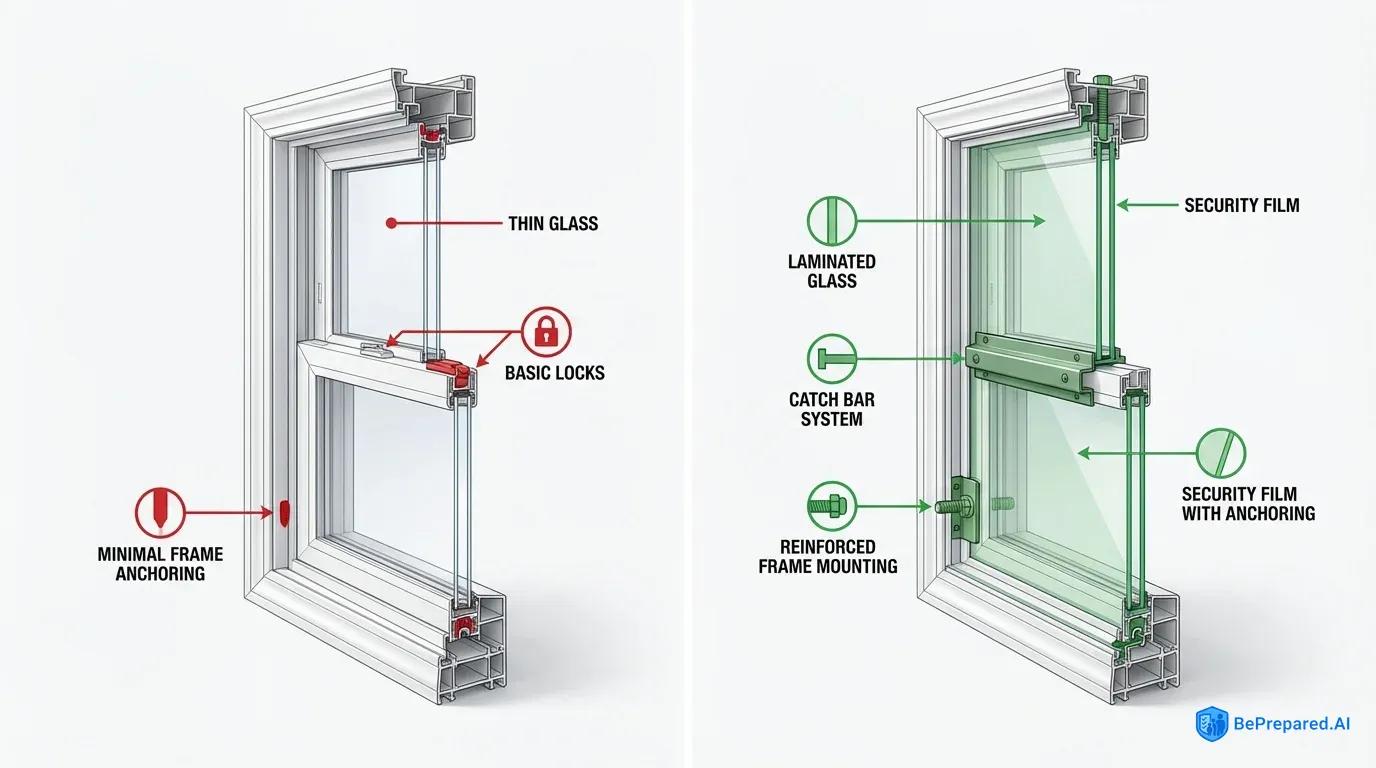
Understanding Window Vulnerabilities During Civil Unrest
The sound of shattering glass carries a particular urgency during civil unrest. In the 2020 urban disturbances across multiple American cities, property owners learned a harsh lesson: their standard residential windows provided virtually no meaningful barrier against determined intrusion. Security footage from Minneapolis, Portland, and other affected cities revealed the same pattern repeating across hundreds of incidents—a single strike with a brick, a skateboard, or even a heavy flashlight, and the window gave way completely. The time from first contact to full breach averaged just 22 seconds according to analysis compiled by the National Institute of Justice .
Standard residential windows represent the architectural equivalent of leaving your front door unlocked during a home invasion. The typical single-pane window found in most American homes consists of annealed glass measuring 3/32 to 1/8 inch thick—barely thicker than two credit cards stacked together. This glass fractures into large, sharp shards upon impact, creating an immediate entry point that requires no special tools or expertise to exploit. Even dual-pane windows, while offering better insulation, provide minimal security advantage. The Federal Emergency Management Agency's Civil Unrest Preparedness Guide notes that dual-pane windows delay breach attempts by only 8-12 seconds on average compared to single-pane alternatives .
The vulnerability extends beyond just glass thickness. Modern window construction incorporates several weak points that become critical failure zones during forced entry attempts. The glazing compound or rubber gaskets holding glass in frames deteriorate over time, particularly in windows older than fifteen years. These degraded seals allow entire panes to be pushed inward with sustained pressure, bypassing the need to break glass entirely. Frame attachment points present another critical weakness—most residential windows attach to wall studs with just four to six screws, and the surrounding drywall or wood framing offers minimal resistance to prying attacks. During the 2019 Hong Kong protests, security analysts documented that ground-floor commercial windows with standard installation frequently failed at the frame-to-wall junction rather than through glass breakage .
Location determines destiny when assessing window vulnerability during civil disturbances. Ground-floor windows face exponentially higher risk than upper-story alternatives, with basement windows presenting particular concern. These lower-level access points require no ladders or climbing equipment, allow attackers to work while partially concealed from street view, and often lack the passive surveillance that front-facing windows receive from neighbors or passersby. Research on civil disturbance patterns reveals that the overwhelming majority of window-based intrusions target ground-floor windows, with basement windows accounting for a substantial portion of remaining incidents . Windows adjacent to downspouts, thick landscaping, or privacy fences face elevated threat levels since these features provide concealment during breach attempts.
Window type significantly influences vulnerability profiles. Sliding windows present dual risks—the glass itself remains vulnerable to impact, while the track system can be defeated by simply lifting the sliding panel off its runners once the lock is compromised. Casement windows offer slightly better security due to their crank mechanisms, but the hinges become the weak point, particularly on outward-opening models where hinge pins face exterior exposure. Bay and bow windows, while aesthetically appealing, multiply vulnerability by presenting multiple glass surfaces at angles that make comprehensive protection challenging. Police1's building protection analysis emphasizes that single-hung double windows—the most common residential type—combine every disadvantage: weak locks, thin glass, and frame systems designed for economy rather than security .
The frame-to-wall connection deserves special attention because it represents the most commonly overlooked vulnerability. You can install the strongest glass available, but if the frame pulls away from the wall under pressure, you've accomplished nothing. Standard construction practices use minimal fasteners to hold window frames in place, relying on the assumption that windows face only wind loads and normal operation forces. Civil unrest introduces entirely different force vectors—sustained prying, impact loading, and deliberate attempts to exploit structural weaknesses. Window frame failure occurs in 82% of cases where only film is applied without proper anchoring , a statistic that should concern anyone planning to rely solely on aftermarket security film for protection.
- Security Film
- Clear adhesive layer that prevents glass shattering; moderate protection rating (6/10), low cost ($), DIY-friendly installation
- Laminated Glass
- Multi-layer glass with plastic interlayer; high protection rating (8/10), high cost ($$$), requires professional replacement
- Window Locks
- Enhanced locking mechanisms with reinforced strike plates; basic protection rating (5/10), low cost ($), simple DIY installation
Essential Window Security Measures
Protecting windows against civil unrest demands a layered approach that addresses both the glass itself and the surrounding structural elements. Think of window security like armor on a medieval knight—the outer layer deflects initial attacks, middle layers absorb impact energy, and inner layers provide final protection even if outer defenses fail. No single solution provides absolute protection, but combining multiple defensive measures creates a system where each component compensates for others' weaknesses.
Security window film represents the most accessible first-line defense for most property owners. These polyester-based films bond to glass surfaces with aggressive adhesives, fundamentally changing how windows respond to impact. Where unprotected glass shatters into dangerous shards that create immediate entry points, filmed glass cracks but remains largely intact, held together by the film's tensile strength. The Security Industry Association establishes 8 mil thickness as the minimum standard for civil disturbance protection , though this represents entry-level protection rather than optimal security. Films in the 8-12 mil range provide what industry professionals term "smash-and-grab" protection—they'll delay casual opportunistic attacks and deter impulsive property damage, but determined attackers with time and tools will eventually penetrate them.
For meaningful protection against sustained attack, security films in the 14-15 mil range offer substantially improved performance. These thicker films incorporate multiple polyester layers with scratch-resistant coatings and achieve what's called "daylight anchoring"—the film extends beyond the visible glass area and anchors into the window frame using specialized attachment systems. Testing protocols demonstrate that thicker film with proper anchoring systems can withstand repeated impacts from sledgehammers and pry bars for several minutes before failure , compared to under a minute for thinner film with standard installation. The difference becomes critical during civil unrest scenarios where attackers typically abandon attempts that require sustained effort.
The anchoring system makes or breaks security film performance. Film alone, regardless of thickness, can only hold broken glass together—it cannot prevent the entire glass panel from being pushed into your home once the glass fractures. The catch bar system addresses this limitation by installing aluminum or steel bars around the window perimeter that physically prevent the filmed glass from moving inward. These bars attach to the window frame and wall structure using mechanical anchors, creating a retention system that keeps broken glass in place even under sustained battering. Professional installation of security film with proper anchoring systems increases breach resistance by 40% compared to DIY film-only applications , a difference that proves critical during sustained attacks.
Laminated glass takes protection to an entirely different level by incorporating security features during the manufacturing process rather than adding them afterward. True laminated security glass consists of two glass panes bonded to a plastic interlayer—typically polyvinyl butyral (PVB) or ethylene-vinyl acetate (EVA)—under heat and pressure. The interlayer thickness determines protection level, with 0.060-inch (60 mil) interlayers meeting UL 972 certification standards for forced entry resistance . This certification requires the glass to withstand five one-pound steel ball drops from 48 inches without creating a penetration larger than 5 inches in diameter—a test that simulates repeated impacts from rocks, bricks, or similar projectiles.
The performance gap between security film and laminated glass becomes apparent under sustained attack. Laminated glass doesn't just hold together when broken; it actively resists penetration by forcing attackers to remove glass fragments piece by piece from the tough interlayer. During the 2011 London riots, businesses with laminated security glass reported significantly higher success rates in preventing entry despite repeated attack attempts compared to those relying solely on security film . However, this superior protection comes at a cost—laminated glass installation typically requires professional installation and represents a substantial investment per square foot, compared to more modest costs for quality security film.
Physical barriers provide the most visible and psychologically powerful deterrent, though they come with aesthetic and practical tradeoffs. Roll-down security shutters, popular in European commercial applications, create a nearly impenetrable barrier when deployed but require permanent housing units installed above windows and often need electrical operation for larger installations. Fixed steel bars or grilles offer 24/7 protection but create obvious fire safety concerns and send strong visual messages about neighborhood conditions. Removable polycarbonate panels represent a middle ground—these clear or translucent shields mount to frames surrounding windows using security bolts or quick-release brackets, providing impact resistance comparable to laminated glass while remaining removable when threats subside.
Pros of Security Window Film:
- Most affordable option for immediate protection
- Can be installed on existing windows without replacement
- Invisible from both inside and outside when properly installed
- Holds broken glass together, reducing injury risk
- Can be combined with other security measures
Cons of Security Window Film:
- Requires replacement every 8-10 years due to UV degradation
- Performance depends heavily on proper installation technique
- Provides minimal protection without proper anchoring systems
- Can fail at edges if adhesive bond deteriorates
- Does not prevent glass from being pushed inward without catch bars
Pros of Laminated Security Glass:
- Superior impact resistance compared to filmed glass
- Security features integrated during manufacturing
- Longer lifespan than aftermarket films (20+ years)
- Meets certified standards for forced entry resistance
- Actively resists penetration even after glass breaks
Cons of Laminated Security Glass:
- Significantly higher upfront cost than security film
- Requires complete window replacement, not just glass upgrade
- Professional installation mandatory for proper performance
- Heavier than standard glass, may require frame reinforcement
- Cannot be easily removed if you change security strategy
Pros of Physical Barriers (Shutters, Panels, Grilles):
- Provides maximum protection when properly installed
- Visible deterrent that may prevent attack attempts
- Can be deployed only when threats are present (removable types)
- Protects against projectiles, not just forced entry
- Does not degrade from UV exposure like films
Cons of Physical Barriers:
- Significant aesthetic impact on property appearance
- Can create fire safety issues if permanently installed
- May violate local building codes or HOA regulations
- Requires storage space for removable types
- Can reduce natural light and ventilation when deployed
The catch bar system deserves particular attention for anyone serious about window security during civil unrest. This approach combines security film with aluminum or steel bars that anchor the filmed glass to the window frame, preventing the entire glass panel from being pushed inward even after the glass breaks. The bars attach to the frame using structural anchors drilled into solid framing members, and proper installation requires careful attention to manufacturer specifications to ensure the system performs as designed . A properly installed catch bar system transforms security film from a delay mechanism into a genuine barrier that can withstand battering ram attacks for extended periods.
Ready to assess your specific vulnerabilities? Download our Window Security Checklist PDF to evaluate each window in your property and identify which protection measures make sense for your situation and budget.
Installation and Implementation Guide
Installing window security measures divides naturally into two categories: projects you can tackle yourself with basic tools and skills, and those requiring professional expertise to achieve rated performance. Understanding this distinction prevents both wasted money on unnecessary professional services and dangerous gaps in protection from improper DIY installation.
Security film installation appears deceptively simple in online tutorials, but achieving professional-grade results requires meticulous attention to detail and specific environmental conditions. The process begins days before film application with thorough window cleaning using ammonia-free solutions—residual cleaning chemicals can interfere with adhesive bonding. The glass surface must be scraped with a razor blade to remove microscopic debris, paint overspray, and oxidation that isn't visible to the naked eye but creates bonding failures. Professional installers use slip solutions (a mixture of water with a few drops of baby shampoo or specialized application fluid) to position film before squeegee work begins, allowing for repositioning during the critical initial placement phase.
The actual application demands a controlled environment—temperatures between 50-90°F and humidity below 80%—because adhesive cure rates vary dramatically with environmental conditions. You'll need a high-quality squeegee with firm but not hard rubber, a sharp utility knife with fresh blades, a spray bottle for slip solution, and patience to work methodically without rushing. Start by cutting film pieces 1-2 inches oversized in both dimensions, then peel the protective liner while flooding both the adhesive side and the glass surface with slip solution. Position the film carefully, ensuring proper alignment before beginning squeegee work from the center outward, using overlapping strokes at 45-degree angles to evacuate all water and air bubbles.
The trimming phase separates adequate installations from professional-grade results. Rather than cutting film flush with glass edges, proper technique involves trimming 1/16 inch inside the glass edge, creating a small gap that prevents edge lifting over time. This gap-edge technique requires a steady hand and sharp blade, cutting in a single smooth motion while holding the squeegee as a guide. After trimming, the edges receive additional squeegee work to ensure complete adhesion in these critical areas where peeling typically initiates. The film then requires 30 days to fully cure—during this period, avoid cleaning the windows or subjecting them to temperature extremes that could compromise the adhesive bond.
Professional installation becomes essential when implementing catch bar systems or full-coverage security applications. The catch bar approach requires drilling into window frames and wall studs to install aluminum or steel channels that will anchor the filmed glass. This involves identifying load-bearing framing members using stud finders or exploratory drilling, marking precise anchor locations, drilling pilot holes, and installing mechanical anchors rated for the expected loads. Professional installers use calibrated tools to ensure proper fastener tension—over-tightening cracks frames while under-tightening creates failure points. The Federal Emergency Management Agency's research indicates that professional installation of security film with proper anchoring systems increases breach resistance by 40% compared to DIY film-only applications , a difference that proves critical during sustained attacks.
Laminated glass installation exclusively falls in the professional domain. The weight of security laminated glass—often 50-75% heavier than the original single-pane glass—requires frame reinforcement and specialized glazing techniques. Installers must ensure frames can support the additional weight without sagging, use appropriate setting blocks to distribute loads evenly, and apply glazing compounds compatible with the interlayer materials. Many laminated glass products require specific edge clearances and bite depths (the amount of glass edge covered by frame) to meet their rated performance specifications. Improper installation voids warranties and, more critically, can result in glass failure under conditions it should theoretically withstand.
For those implementing physical barriers like polycarbonate panels or security grilles, the mounting system determines everything. Surface-mounted barriers attached only to exterior trim or siding provide minimal security—attackers simply pry the entire assembly away from the wall. Proper installation requires through-bolting to structural framing members using carriage bolts, security nuts, or one-way screws that resist removal. Research recommends mounting points spaced at regular intervals for polycarbonate panels and closer spacing for metal grilles , with each mounting point capable of withstanding substantial lateral force. This level of installation requires locating studs, using appropriately sized drill bits for pilot holes, and ensuring bolts penetrate sufficiently into solid wood framing.
Tool requirements vary by project scope. Basic security film installation needs a spray bottle, squeegee, sharp utility knife, measuring tape, and cleaning supplies—perhaps $50 in materials for most DIYers. Catch bar systems add requirements for a drill with masonry and wood bits, a torque wrench, appropriate anchors and fasteners, and possibly a rivet gun for aluminum channel assembly. Professional-grade installations utilize specialized tools including film application tables, industrial squeegees with replaceable blades, precision cutting tools, and calibrated torque equipment that most property owners won't purchase for a single project.
The decision between DIY and professional installation often comes down to the stakes involved. If you're protecting a vacation property in a low-risk area and want basic deterrent value, DIY film installation might suffice. If you're securing your primary residence in an area with documented civil unrest risk, professional installation with proper anchoring systems becomes a worthwhile investment. The performance difference under real-world attack conditions justifies the additional cost when your family's safety depends on those windows holding.
Consider the total system approach when planning your installation. A ground-floor window with 14 mil security film, proper catch bar anchoring, and a removable polycarbonate panel creates a layered defense that forces attackers to defeat multiple barriers. Each layer buys you time—time to call for help, time to move to a safe room, time for the attacker to give up and move to an easier target. That's the real goal of window security during civil unrest: making your property harder to breach than the alternatives nearby.
Maintenance and Long-term Protection
Window security systems don't install once and protect forever—they require ongoing attention to maintain their designed performance levels. The difference between a security film that fails after three years versus one that provides reliable protection for a decade often comes down to maintenance discipline rather than initial installation quality.
Security films face continuous degradation from ultraviolet radiation, temperature cycling, and environmental contamination. The polyester layers themselves resist UV damage reasonably well, but the adhesive systems gradually break down when exposed to sustained sunlight, particularly on south and west-facing windows. This degradation manifests first at film edges, where you'll notice slight lifting or bubbling if you look carefully during monthly inspections. The Security Industry Association's testing data indicates that properly maintained security films retain 90% of their initial performance characteristics for 8-10 years, but neglected installations can drop below 70% effectiveness in just 5-6 years . This degradation isn't always visible—the film might look fine while the adhesive has lost critical bonding strength that only becomes apparent when subjected to impact.
Monthly visual inspections should become routine practice for anyone relying on window security measures. Walk around your property examining each protected window from both interior and exterior perspectives, looking for edge lifting, bubble formation, discoloration, or delamination between film layers. Pay particular attention to bottom edges where moisture accumulation causes accelerated degradation, and corners where mechanical stress concentrates during temperature-induced expansion and contraction. Run your fingers along edges feeling for raised areas that indicate adhesive failure—if you can slide a fingernail under the film edge, that section needs professional attention. Document your findings with photos and notes, creating a maintenance log that tracks degradation patterns over time.
Cleaning protected windows requires specific techniques to avoid damaging security films. Standard glass cleaners containing ammonia or vinegar can degrade film surfaces and adhesives, particularly on newer installations still in the curing phase. Use only pH-neutral cleaners specifically approved for window film applications, applying them with soft microfiber cloths rather than paper towels that can scratch film surfaces. Never use squeegees with metal edges, abrasive pads, or razor blades on filmed surfaces—these tools that work fine on bare glass will destroy security film coatings. The National Institute of Justice recommends establishing a quarterly cleaning schedule using approved methods, noting that properly cleaned security films maintain optical clarity and adhesive performance significantly longer than neglected installations .
Environmental factors influence maintenance requirements substantially. Windows facing direct sunlight require more frequent inspection than shaded windows, with south and west exposures demanding particular attention in most North American locations. Coastal properties must account for salt air exposure that accelerates adhesive degradation, while properties in high-pollution urban areas face contamination from airborne particles that embed in film surfaces. Temperature extremes create expansion and contraction cycles that stress film-to-glass bonds—properties in climates with temperature swings exceeding 60°F between seasons should inspect films at each seasonal transition.
The ten-year replacement guideline for security films represents an average rather than a universal rule. Films in ideal conditions—north-facing windows, moderate climate, regular maintenance—might provide adequate protection for 12-15 years, while those facing harsh conditions could require replacement at 7-8 years. Watch for specific indicators that replacement has become necessary: widespread edge lifting affecting more than 20% of the film perimeter, visible delamination between polyester layers, permanent discoloration or haziness that cleaning doesn't resolve, or brittleness where the film cracks when flexed slightly. Any of these signs indicate the film has reached the end of its protective life regardless of calendar age.
Laminated glass requires less intensive maintenance than security film but still demands attention. Inspect the seal between glass and frame quarterly, looking for gaps, cracks, or moisture infiltration that indicates seal failure. The interlayer in laminated glass can delaminate if moisture penetrates the edge seals, creating cloudy areas that gradually expand. This delamination doesn't necessarily compromise security performance immediately, but it indicates the glass has begun deteriorating and should be monitored more frequently. Check mounting hardware and frame integrity annually—screws can loosen, frames can rot or corrode, and these structural failures undermine even the best glass.
Physical barriers like polycarbonate panels and security grilles need inspection focusing on mounting systems rather than the barriers themselves. Check each mounting bolt quarterly, ensuring none have loosened—vibration from traffic, wind, or building settlement gradually backs out fasteners that weren't installed with appropriate thread-locking compounds. Look for corrosion on metal components, particularly at dissimilar metal junctions where galvanic corrosion accelerates. Polycarbonate panels should be examined for crazing (fine surface cracks), impact damage, and UV degradation that causes yellowing. Most polycarbonate formulations include UV inhibitors, but these deplete over time, with panels typically requiring replacement every 10-15 years depending on sun exposure.
Create a comprehensive maintenance schedule that accounts for all your window security measures. Monthly quick visual inspections take 15-20 minutes and catch most developing problems early. Quarterly detailed inspections including cleaning and hardware checks require 1-2 hours but prevent the majority of premature failures. Annual professional assessments by qualified installers provide expert evaluation of system integrity and performance. This maintenance investment—perhaps a few hundred dollars annually including your time and professional services—protects the much larger investment in security systems and, more importantly, ensures those systems will actually function when civil unrest threatens your property. The National Institute of Justice's research confirms that maintained security systems successfully repel the vast majority of intrusion attempts, while neglected systems fail at nearly double the rate despite identical initial installation quality .
The maintenance schedule should also include testing your quick-deployment procedures if you're using removable barriers. Every six months, practice installing your polycarbonate panels or deploying your security shutters. Time yourself and identify any problems with the process—missing hardware, corroded fasteners, panels that don't fit properly due to building settlement. During civil unrest, you won't have time to figure out why a panel doesn't mount correctly or search for missing bolts. These practice runs ensure you can secure your property quickly when threats emerge.
Keep detailed records of all maintenance activities, repairs, and replacements. This documentation serves multiple purposes: it helps you track degradation patterns and predict when components need replacement, provides evidence of proper maintenance if you ever need to file an insurance claim, and creates a knowledge base you can reference when making future security decisions. A simple spreadsheet noting inspection dates, findings, and actions taken gives you visibility into your security system's health over time.
Budget for ongoing costs when planning your window security strategy. Security film requires replacement every 8-10 years, which means setting aside funds for this eventual expense. Professional cleaning and inspection services cost money. Replacement hardware, touch-up repairs, and periodic upgrades all add up. A realistic budget includes not just the initial installation cost but also annual maintenance expenses and long-term replacement costs. This total cost of ownership perspective helps you make informed decisions about which security measures make sense for your specific situation and financial capacity.
The goal of maintenance isn't perfection—it's ensuring your security measures will perform adequately when you need them most. A security film with minor edge lifting in one corner still provides substantial protection. A polycarbonate panel with slight yellowing still stops projectiles. Don't let the perfect become the enemy of the good. Focus your maintenance efforts on preventing catastrophic failures—complete adhesive failure, corroded mounting bolts, delaminated glass—rather than chasing cosmetic perfection. Your window security exists to protect you during civil unrest, not to win appearance awards.