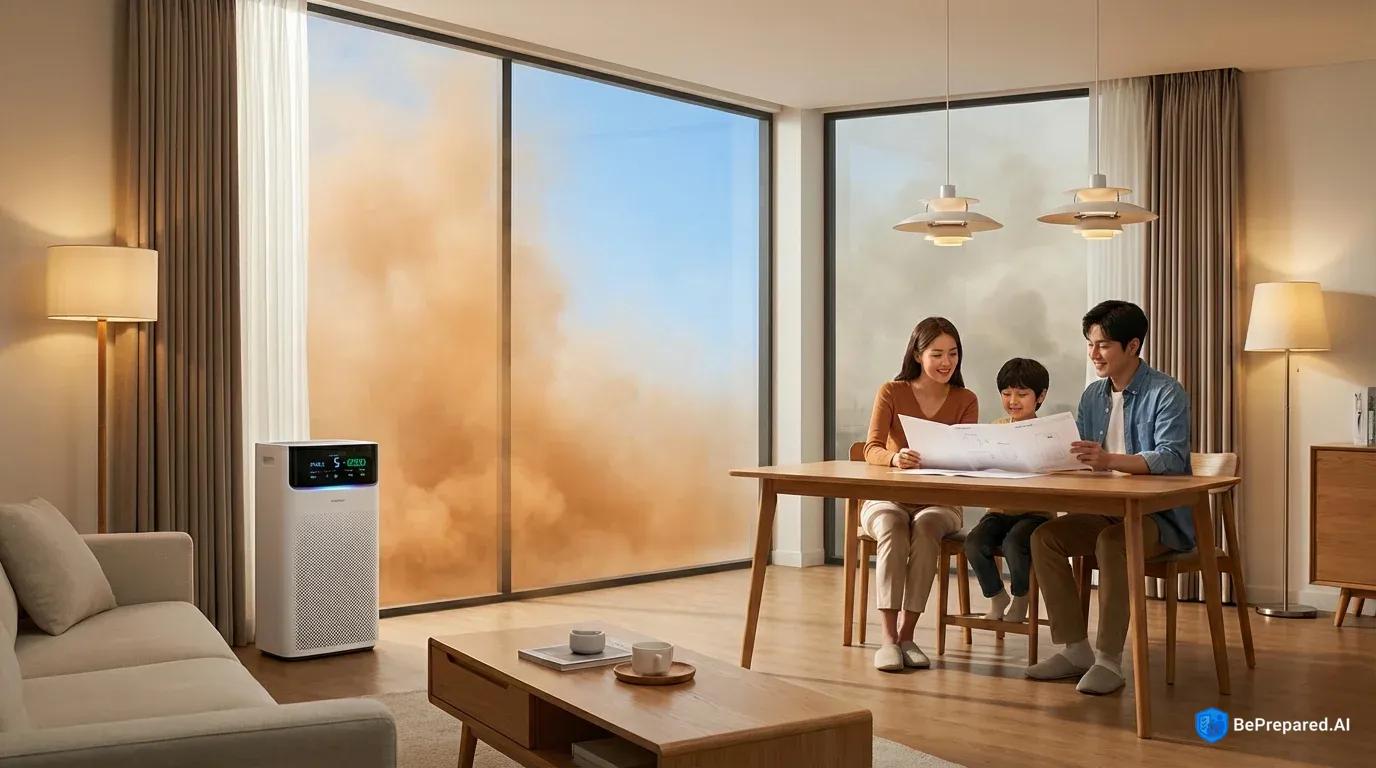
Understanding Air Purifier Sizing for Wildfire Smoke Protection
Last summer, Sarah watched from her Seattle apartment as an orange haze descended over the city. The air quality index climbed past 200, then 300. She'd bought an air purifier the year before after a friend's recommendation, but as smoke seeped through every crack in her building, she wondered if her small bedroom unit could actually protect her family's health. Like many people facing their first serious wildfire smoke event, she'd never considered whether her purifier was actually sized correctly for the job.
The difference between adequate and inadequate air purification during wildfire events isn't subtle—it's the difference between breathing relatively clean air and exposing yourself to hazardous particle concentrations for days or weeks at a time. Research consistently demonstrates that properly sized air purifiers can reduce indoor particle concentrations by 50% or more during wildfire smoke events . This isn't just about comfort; fine particulate matter from wildfire smoke penetrates deep into lung tissue and enters the bloodstream, creating serious health risks even for healthy adults.
The challenge lies in understanding what "properly sized" actually means. Most people purchase air purifiers based on price point or brand recognition, treating them like any other appliance. But an air purifier that works beautifully for everyday dust and allergens in a small bedroom might be completely overwhelmed when smoke infiltrates a larger living space. The unit runs continuously, the filter clogs rapidly, and indoor air quality remains dangerously poor despite your investment. Incorrect sizing doesn't just lead to inadequate protection—it creates a false sense of security that can be genuinely dangerous during extended smoke events.
The physics of air purification are straightforward: your purifier needs to move enough air through its filters to clean your entire room volume multiple times per hour. During wildfire conditions, when outdoor particle concentrations can be hundreds of times higher than normal and buildings leak smoke continuously, this becomes even more critical. Understanding how to calculate your actual needs based on room size, ceiling height, and the severity of smoke conditions transforms air purification from guesswork into reliable protection.
Essential Measurements and Calculations
Calculating your air purifier needs requires three fundamental measurements and one key performance metric. Start with your room's length and width in feet. A typical bedroom might measure 12 feet by 14 feet, giving you 168 square feet of floor space. Many people stop here, assuming this number tells them everything they need to know. This approach works for carpeting or paint, but air fills three-dimensional space, not just floor area.
Ceiling height transforms your calculation from square footage to cubic volume. That same 168-square-foot bedroom with standard 8-foot ceilings contains 1,344 cubic feet of air. If your home has 9-foot or 10-foot ceilings—increasingly common in modern construction—the same floor space contains 1,512 or 1,680 cubic feet respectively. This 25% difference in air volume directly translates to a 25% difference in the purifier capacity you need.
Vaulted ceilings, lofts, and spaces with cathedral ceiling sections require even more careful measurement. Measure at the highest point and calculate conservatively, erring toward treating the space as if the entire ceiling sits at that height. This approach prevents underestimating your needs and ensures adequate protection when smoke arrives.
The concept of air changes per hour (ACH) determines how frequently your purifier should cycle through your room's entire air volume. Under normal conditions, 2-3 air changes per hour maintains good indoor air quality. During wildfire smoke events, however, you need 4-6 air changes per hour . Think of it like bailing water from a leaking boat—the faster the leak, the faster you need to bail. Smoke doesn't enter your home once and stop; it seeps in continuously through gaps around windows, doors, and ventilation systems. Your purifier must clean faster than smoke infiltrates.
This is where Clean Air Delivery Rate (CADR) becomes essential. CADR measures how many cubic feet of clean air a purifier delivers per minute, tested and certified by independent laboratories . The calculation connecting room volume, desired air changes, and required CADR follows a simple formula: multiply your room's cubic feet by your desired air changes per hour, then divide by 60 minutes.
For our 168-square-foot bedroom with 8-foot ceilings, targeting 5 air changes per hour means (1,344 cubic feet × 5) ÷ 60 = 112 cubic feet per minute minimum CADR. This number represents your baseline requirement—the minimum capacity needed to achieve your target air change rate.
The EPA recommends your CADR should equal at least two-thirds of your room's square footage for smoke particles . This rule of thumb assumes standard ceiling heights and moderate air change rates. For our 168-square-foot bedroom, this suggests a minimum smoke CADR of 112 CFM—which happens to align closely with our more detailed calculation.
During active wildfire events, treating this as your minimum rather than your target provides better protection. For wildfire smoke protection, choose units with CADR ratings that are 1.5 times your room's square footage . A purifier rated for 250 smoke CADR would deliver the 5-6 air changes per hour that genuinely clears smoke effectively in this bedroom.
Pay attention to CADR ratings for different particle types. Manufacturers typically list three CADR numbers: smoke (the smallest particles), dust (medium particles), and pollen (largest particles). Wildfire smoke consists primarily of fine and ultrafine particles, making the smoke CADR the only number that matters for this application. A purifier might boast impressive pollen CADR while offering inadequate smoke CADR—exactly the opposite of what you need during fire season.
Understanding these measurements gives you the foundation for making informed decisions. You're no longer guessing based on marketing claims or relying on sales staff who may not understand the technical requirements. You can walk into a store or browse online with specific numbers in hand, comparing actual performance metrics against your calculated needs.
Interactive Calculator Tool
Calculating your air purifier requirements becomes straightforward when you break the process into sequential steps. Start by gathering your room measurements with a tape measure, measuring the longest wall length, the widest width, and the ceiling height at its tallest point. Write these numbers down—you'll use them multiple times as you evaluate different purifier options.
Step 1: Calculate Room Volume
Multiply length × width × height to get cubic feet. For a living room measuring 20 feet long, 15 feet wide, with 9-foot ceilings: 20 × 15 × 9 = 2,700 cubic feet. If you're working with a space that has irregular dimensions or an L-shape, break it into rectangles, calculate each section separately, then add them together. Precision matters less than being comprehensive—it's better to slightly overestimate than to miss a significant area.
Step 2: Determine Required Air Changes
Select your target air changes per hour based on conditions. Use 2-3 ACH for general air quality maintenance during normal conditions, 4-5 ACH for moderate wildfire smoke, and 5-6 ACH for heavy smoke or if you have vulnerable household members with respiratory conditions, heart disease, or other health sensitivities. During California's 2020 fire season, many families found that 6 ACH made the difference between tolerable and intolerable indoor conditions during multi-week smoke events .
Step 3: Calculate Minimum CADR
Take your cubic feet and multiply by desired air changes per hour, then divide by 60. For our 2,700 cubic foot living room targeting 5 air changes: (2,700 × 5) ÷ 60 = 225 CFM minimum smoke CADR. This represents your baseline—the absolute minimum capacity that will achieve your target air change rate under ideal conditions.
Step 4: Apply Real-World Adjustment
Add 20-30% to your calculated CADR to account for filter aging, less-than-optimal placement, and the reality that manufacturers test in laboratory conditions. Your adjusted target for this living room becomes 270-293 CFM smoke CADR. This buffer ensures effective performance even as filters accumulate particles and airflow gradually decreases between changes.
Step 5: Verify Using the Two-Thirds Rule
Cross-check your calculation using the EPA's simplified guideline. The EPA recommends your CADR should equal at least two-thirds of your room's square footage for smoke particles . Our 300-square-foot living room (20 × 15) suggests 200 CFM minimum, which our more detailed calculation exceeds—confirming we're in the right range.
Download our Air Purifier Sizing Worksheet to access a printable calculator that walks through these steps with space to record measurements for every room in your home, compare multiple purifier options, and track your filter replacement schedule.
When shopping for purifiers, verify that the CADR ratings come from independent testing certified by the Association of Home Appliance Manufacturers (AHAM) . Look for the AHAM Verifide seal, which confirms that the manufacturer's claims have been validated through standardized testing. Some companies advertise coverage area in square feet, but these claims often assume unrealistically high ceilings or low air change rates. Always verify the actual smoke CADR number rather than relying on square footage marketing claims.
These calculations might seem technical at first, but they become second nature after you work through them once or twice. The investment of 15 minutes with a tape measure and calculator can save you from buying inadequate equipment or wasting money on oversized units you don't need. You'll know exactly what performance level to look for, making comparison shopping straightforward and eliminating the confusion that typically surrounds air purifier purchases.
- Open-Plan Living Area (20' x 30')
- Multiple unit configuration for 600 sq ft space with vaulted 12' ceiling, requiring 7,200 cubic feet of coverage
Adjusting for Multiple Rooms and Special Conditions
Open floor plans fundamentally change air purifier calculations because air moves freely between connected spaces. Consider a modern home with a combined kitchen, dining, and living area. Even though you might think of these as three separate rooms, air circulates throughout the entire space. A purifier in the living room corner doesn't just clean living room air—it processes air from the entire connected volume.
Calculate open floor plans by treating the entire connected space as a single large room. Measure the full length and width of the combined area, including the kitchen, dining space, and living room. A typical open concept main floor might span 35 feet by 25 feet with 9-foot ceilings, creating 7,875 cubic feet of air volume. At 5 air changes per hour, you need 656 CFM smoke CADR—substantially more than any single residential air purifier provides.
This is where the single-purifier approach breaks down and you need to think strategically about multiple units. Multiple smaller air purifiers can be more effective than a single large unit . Two purifiers rated at 350 CFM each, positioned at opposite ends of your open floor plan, create better air circulation patterns than trying to find one massive unit. They draw from different areas, process air more evenly throughout the space, and provide redundancy if one unit fails.
Contrast this with a traditional home layout where rooms have doors that can be closed. A 200-square-foot bedroom with a door you can seal with weatherstripping functions as an isolated space. You can achieve excellent air quality in this room with a properly-sized purifier rated for 300 CFM smoke CADR (using the 1.5x square footage guideline), regardless of conditions elsewhere in your home.
Many families during wildfire events adopt a "clean room" strategy, focusing their purification efforts on one or two rooms where they spend most of their time, particularly sleeping areas. This approach requires less equipment investment than trying to purify an entire home. You create a refuge where air quality remains good, even if other areas of your house have elevated particle levels.
The comparison between open and closed spaces reveals an important principle: every doorway, hallway, or stairwell that allows air circulation expands your effective room volume. A primary bedroom suite with an attached bathroom and walk-in closet might seem like separate spaces, but if doors stay open, you're actually purifying 400-500 square feet rather than just the 200-square-foot bedroom. Either close doors to reduce the volume each purifier must handle, or calculate based on the full connected space.
High ceilings demand special attention because volume increases faster than most people intuitively expect. A great room with 18-foot vaulted ceilings contains more than twice the air volume of the same floor area with 8-foot ceilings. That dramatic difference means you need more than twice the CADR to achieve the same air change rate. A 400-square-foot great room with 18-foot ceilings contains 7,200 cubic feet—requiring 600 CFM smoke CADR for 5 air changes per hour. The same floor space with standard ceilings needs only 267 CFM.
Basements present another special case, particularly finished basements with multiple rooms and lower ceiling heights. A basement with 7-foot ceilings contains less air volume than the same floor area upstairs, which might suggest you need less purification capacity. However, basements often have additional air quality challenges including higher humidity, potential mold issues, and less natural air exchange. Calculate based on actual volume but consider maintaining the same ACH target you use upstairs rather than reducing it.
Rooms with significant air leakage—older homes with single-pane windows, spaces with exterior doors that open frequently, or rooms with window air conditioning units—require higher air change rates to compensate for continuous smoke infiltration. If your calculation suggests 200 CFM CADR but you're dealing with a drafty room, target 250-300 CFM instead. The additional capacity compensates for the reality that you're fighting a constant influx of contaminated outdoor air.
Weatherstripping doors and sealing obvious gaps around windows can dramatically improve your purifier's effectiveness by reducing the rate at which smoke infiltrates. A roll of foam weatherstripping costs less than $10 and can reduce air leakage by 30-50%, effectively making your purifier work as if it had 30-50% more capacity. This simple upgrade often makes the difference between adequate and excellent air quality during smoke events.
Pros and Cons of Different Sizing Approaches
Oversizing Your Purifier
Buying a purifier with higher CADR than your calculations suggest offers several advantages. The unit runs on lower fan speeds to achieve your target air changes, operating more quietly and consuming less energy. Filters last longer because air moves through them more slowly, reducing the frequency of replacements. You gain flexibility to use the purifier in larger spaces if your needs change.
The downsides include higher upfront cost and larger physical size. Units with higher CADR ratings typically cost 30-50% more than models rated for your exact needs. They also occupy more floor space, which matters in smaller rooms or apartments where every square foot counts.
Exact Sizing to Your Calculations
Purchasing a purifier that matches your calculated requirements provides the most cost-effective solution. You pay only for the capacity you need, and the unit size remains manageable for your space. This approach works well when you have a clear understanding of your requirements and don't anticipate changes.
The limitation is reduced flexibility. If you move the purifier to a larger room, it won't perform adequately. As filters age and airflow decreases, you have no performance buffer. You'll need to run the unit on higher fan speeds, which increases noise and energy consumption.
Multiple Smaller Units vs. One Large Unit
For large spaces, multiple smaller purifiers distributed throughout the room often outperform a single large unit. Multiple smaller air purifiers can be more effective than a single large unit . They create better air circulation patterns, reduce dead zones where air doesn't move effectively, and provide redundancy if one unit fails or needs filter replacement.
The trade-offs include higher total cost (two 300 CFM units typically cost more than one 600 CFM unit), more floor space occupied, and more filters to track and replace. You'll also use more electrical outlets, which can be limiting in older homes with fewer receptacles.
The Clean Room Strategy
Focusing purification efforts on one or two critical rooms rather than your entire home minimizes equipment investment while ensuring excellent air quality where it matters most. You can afford higher-quality purifiers for these spaces and maintain them more diligently. This approach works particularly well for renters or people on limited budgets.
The obvious limitation is that air quality in other areas of your home remains poor. You need to stay in your designated clean rooms to benefit from the protection, which can feel restrictive during extended smoke events lasting weeks.
Implementation and Maintenance Guidelines
Placement determines whether your carefully calculated purifier capacity translates into actual air quality improvement. Air purifiers work by drawing contaminated air through their intake vents, passing it through filters, and expelling cleaned air back into the room. This creates circulation patterns that either enhance or diminish effectiveness depending on where you position the unit.
Central placement in a room generally maximizes efficiency by allowing the purifier to draw from and distribute to all areas more equally. Position your unit away from walls and furniture to prevent blocking air intake or output. Many people instinctively push purifiers against walls or into corners to keep them out of the way, but this placement can reduce effectiveness by restricting airflow patterns.
If floor space is limited, placement near a wall is acceptable, but leave clearance on the sides where air intakes are located. Check your specific model's manual for recommended clearances—these vary by design. Some units intake air from the front and sides, while others draw primarily from the back or bottom.
Height affects distribution patterns significantly. Floor placement works well for most situations because smoke particles, despite being airborne, tend to settle and accumulate in lower air layers, especially in still conditions. However, if you're dealing with a room where smoke enters primarily through upper-level gaps—perhaps around a ceiling-mounted ventilation fan or high windows—elevating the purifier on a small table or stand positions it closer to the contamination source. Never place purifiers on high shelves or furniture where the expelled clean air simply rises to the ceiling without mixing into the breathing zone.
Running multiple purifiers in large spaces requires strategic positioning to avoid creating dead zones where air doesn't circulate effectively. In a large open floor plan requiring 600 CFM total capacity, two 300 CFM units positioned at opposite ends of the space outperform a single 600 CFM unit because they create circulation patterns that reach more areas. Place one purifier near the kitchen area and another near the living space, both positioned to pull air from the center of the room rather than from walls. This creates complementary circulation patterns that process air throughout the entire space.
During active wildfire smoke events, operate purifiers continuously on high settings rather than cycling them on and off or running them on low. Smoke infiltration is continuous, and your purification efforts must match that continuity. Many modern purifiers include automatic modes that adjust fan speed based on detected particle levels—these work reasonably well under moderate conditions but may not respond aggressively enough during heavy smoke. Manual high-speed operation ensures maximum air changes when you need them most.
Filter maintenance becomes critical during extended smoke events because wildfire smoke loads filters much faster than normal use. Watch for reduced airflow from your purifier's output vents—a clear sign that the filter is clogging. Many units include filter change indicators, but these typically track runtime hours rather than actual particle loading. During fire season, inspect filters visually every week. If the filter material looks dark gray or black rather than white or light gray, replacement is likely needed regardless of how long it's been installed.
Pre-filters or washable outer filters extend the life of your main HEPA filter by capturing larger particles before they reach the more expensive primary filter. Check and clean these weekly during smoke events—a simple five-minute task that can significantly extend your HEPA filter's effective life. Most pre-filters can be vacuumed or washed with water, though always verify your specific model's instructions. Allow washed pre-filters to dry completely before reinstalling them, as moisture can promote mold growth.
Stock extra filters before fire season begins. A family running two purifiers continuously through a six-week smoke event will need multiple replacement filters. Buying these in advance avoids the frustration of finding filters sold out when smoke arrives and everyone simultaneously realizes they need replacements. Store spare filters in their sealed packaging in a dry location—closets work well, but avoid damp basements or garages where humidity might degrade the filter material before you use it.
Track your filter replacement schedule in writing rather than relying on memory. A simple notebook or smartphone note listing each purifier's location, filter type, and replacement dates ensures you maintain all units properly. During the stress of a smoke event, this record-keeping prevents confusion about which units need service. Note the date, filter model number, and where you purchased it—information that makes reordering quick and eliminates guesswork about compatibility.
Consider investing in an inexpensive air quality monitor to verify your purifier's effectiveness. These devices measure PM2.5 particle concentrations in real-time, allowing you to see the direct impact of your purification efforts. You can test different purifier placements, compare performance before and after filter changes, and confirm that your calculated capacity actually delivers the air quality improvements you expect. Monitors cost $30-150 and provide objective data that takes the guesswork out of air purification.
The investment in proper sizing, strategic placement, and diligent maintenance transforms air purifiers from marginal help into genuine protection. The calculations might seem technical, but they deliver concrete results that you can measure with air quality monitors and feel in your daily comfort and health. You're not just buying equipment—you're building a system that protects your family's respiratory health during the increasingly common and severe wildfire smoke events that now affect communities across North America.
When smoke arrives, you'll have confidence that your preparation was adequate. You'll know your purifiers are sized correctly, positioned optimally, and maintained properly. That confidence allows you to focus on other aspects of smoke event management—staying informed about air quality forecasts, coordinating with family members, managing outdoor activities—rather than wondering whether your air purification setup is actually working.