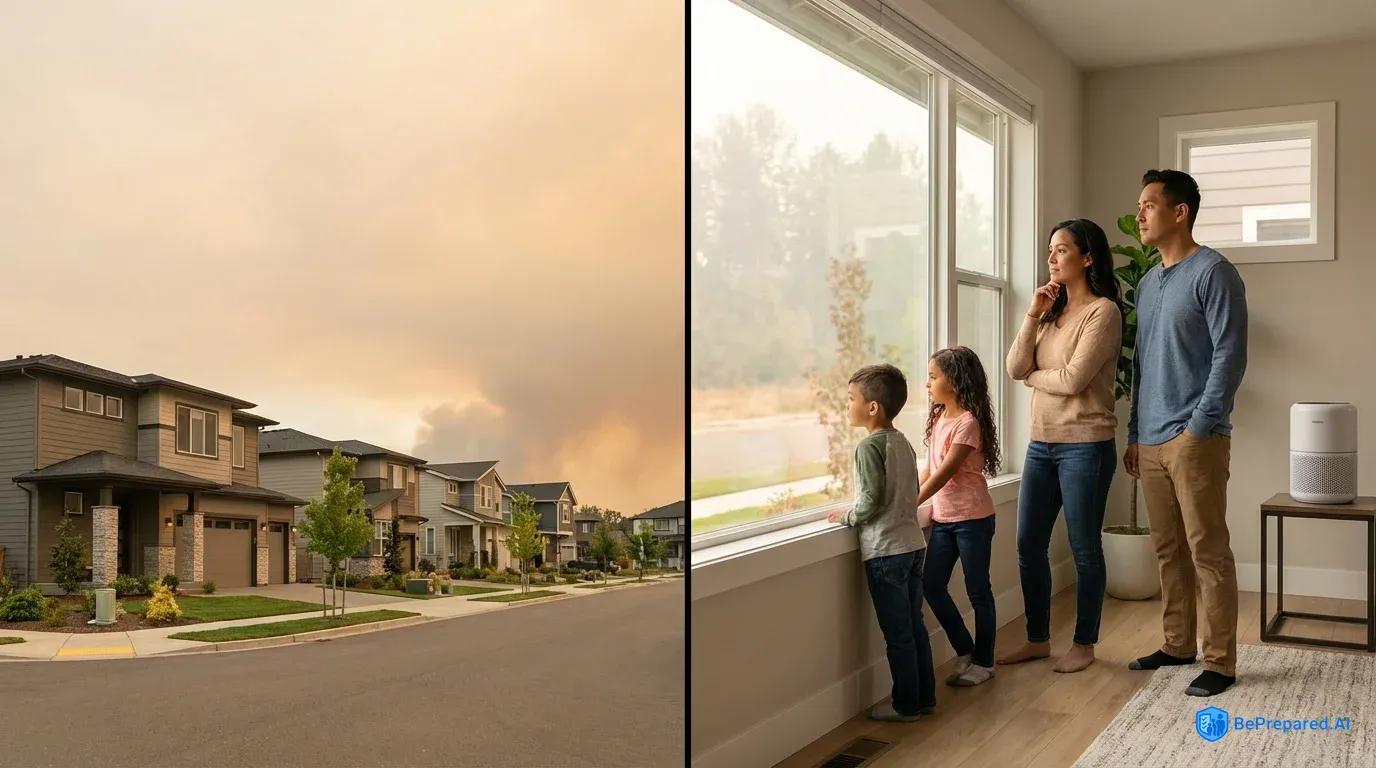
Understanding Wildfire Smoke Risks
Sarah woke up one August morning to an eerie orange glow filtering through her bedroom curtains. The smell hit her immediately—that acrid, campfire scent that meant the wildfires were closer than yesterday. By mid-morning, her throat felt scratchy, and her six-year-old daughter was coughing despite being indoors all day. Sarah hadn't realized that wildfire smoke doesn't need flames nearby to cause serious health problems.
Wildfire smoke contains a dangerous mix of gases and particles. The most concerning component is PM2.5—particulate matter measuring 2.5 micrometers or smaller. To put that in perspective, these particles are roughly 30 times smaller than the width of a human hair. They're small enough to bypass your body's natural defenses and penetrate deep into your lungs. Once there, PM2.5 particles can trigger asthma attacks and heart problems , even in people who've never experienced these conditions before. The smoke doesn't discriminate—it affects healthy adults, too, causing everything from burning eyes and runny noses to more serious respiratory distress.
Some people face heightened risks when smoke fills the air. Children, older adults, pregnant women, and people with heart or lung conditions are especially vulnerable . Children breathe faster than adults and their respiratory systems are still developing, making them particularly susceptible. But here's what surprises many people: outdoor workers, athletes, and anyone who spends significant time outside during smoke events also fall into the high-risk category, regardless of their fitness level.
Understanding the Air Quality Index (AQI) helps you gauge when smoke becomes dangerous. This color-coded scale typically runs from 0 to 500, with green (0-50) representing good air quality and maroon (301-500) indicating hazardous conditions. The critical threshold to remember is 150—AQI values above 150 are unhealthy for everyone , not just sensitive groups. At these levels, even a quick trip to check the mail can expose you to harmful particles. Most weather apps now include AQI readings, transforming your phone into an essential safety tool during fire season.
The good news? You can protect yourself and your family with straightforward steps that don't require special skills or expensive equipment. Let's break down exactly what you need to do, starting with the space where you spend most of your time.
Creating a Clean Air Space at Home
Your home becomes your sanctuary during wildfire smoke events, but only if you prepare it properly. The goal is creating at least one room where the air stays as clean as possible, giving your lungs a place to recover from any outdoor exposure. This clean air space serves as your family's safe haven when the outside world turns hazy and dangerous.
Start by selecting the right room. Your bedroom makes an excellent choice since you'll spend roughly eight hours there anyway. Quality sleep becomes even more important when your body is dealing with smoke exposure. Look for a room with as few windows and doors as possible—fewer openings mean fewer gaps where smoke can sneak inside. The room should be large enough for everyone who'll be sheltering there, but not so large that your air purifier can't handle it effectively. Avoid the kitchen if possible, since cooking generates its own particles that compete with your air cleaning efforts .
Sealing comes next, and this step makes the difference between a regular room and a true clean air space. Walk around your chosen room and identify every potential entry point for outside air. Windows are the obvious culprits, but don't overlook the gaps under doors, around window-mounted air conditioners, or near pipes entering through exterior walls. Use painter's tape or masking tape to seal window edges—it's temporary, inexpensive, and won't damage your paint when you remove it later. For the gap under the door, roll up a towel and press it firmly against the threshold. If you have a window AC unit, either remove it during fire season or seal around it with foam weatherstripping .
Air purifiers transform your sealed room from smoke-reduced to genuinely clean. Air purifiers should match room size with CADR rating —that's the Clean Air Delivery Rate, which tells you how many cubic feet of air the purifier can clean per minute. Match this number to your room size. A purifier rated for 200 square feet won't adequately clean a 400-square-foot master bedroom. Look for units with HEPA filters, which are designed to capture very small particles including PM2.5. Multiple rooms may need separate purifiers, especially if you're sheltering family members in different spaces. Run your purifier continuously during smoke events, not just when you're in the room—maintaining clean air is easier than trying to clean dirty air.
If you have central heating and air conditioning, you can boost your whole-home protection. Use MERV 13 or higher filters in central HVAC systems during wildfires . These filters catch smaller particles than standard filters. Check your system's manual first to make sure it can handle the thicker filter without straining the motor. Change these filters more frequently during heavy smoke periods, as they'll clog faster than usual.
Start your air quality protection plan today by choosing one room to prepare as your clean air space. Walk through it right now, even if no fires are burning nearby. Identify what you'd need to seal it properly, measure the room to determine the right purifier size, and make a shopping list. Preparation before the smoke arrives makes all the difference when you're trying to protect your family's health. You don't need to do everything at once—just pick one action and complete it this week.
- N95 Respirator
- 95% filtration when properly fitted; look for NIOSH approval and ensure no gaps around edges
- KN95 Mask
- Similar to N95, but Chinese standard; check for authentic certification and proper seal around face
Choosing the Right Masks and Respirators
The masks hanging in your garage or tucked in your medicine cabinet might give you a false sense of security. That cloth mask from 2020? The surgical mask from your last doctor's visit? Neither will protect you from wildfire smoke, and wearing them might actually encourage you to spend more time outside than you should.
Real protection comes from respirators, specifically N95 and KN95 models. N95 and KN95 respirators filter at least 95% of airborne particles , including the dangerous PM2.5 found in wildfire smoke. N95 respirators meet U.S. standards set by NIOSH (National Institute for Occupational Safety and Health), while KN95 masks meet Chinese standards. In practical terms, both provide solid protection against smoke when properly worn. The main difference lies in testing protocols and ear loops versus head straps—N95s typically use head straps that create a tighter seal, while KN95s often feature ear loops that some people find more comfortable.
The "properly worn" part trips up many people. A respirator works by forcing all the air you breathe through its filtering material. If gaps exist between the mask and your face, unfiltered air rushes through those openings instead. Start by washing your hands, then position the respirator over your nose and mouth. If you're using an N95 with head straps, place the bottom strap around your neck and the top strap high on the back of your head. Mold the metal nose piece to follow the curve of your nose bridge—this isn't optional, it's essential. The fit test comes next: cup both hands over the respirator and exhale sharply. Air shouldn't puff out around the edges. If it does, readjust and try again .
Facial hair creates problems that no amount of adjusting can fix. Beards, stubble, or even a few days of growth prevent the tight seal that respirators require. If you have facial hair and need smoke protection, you'll get better results by shaving or trimming very close to the skin on the day you need to wear the respirator.
Surgical masks don't protect against smoke particles because they're designed to keep your germs from reaching others, not to filter what you breathe in . The gaps around the edges and the loosely woven material let PM2.5 particles pass right through. Bandanas and cloth masks perform even worse. During smoke events, save the surgical and cloth masks for situations where you're not facing smoke exposure, and rely on your N95 or KN95 when you must go outside during poor air quality.
Timing matters too. Wear your respirator whenever the AQI exceeds 150 and you need to be outdoors. That includes quick trips to your car, checking the mail, or letting the dog out. Brief exposures add up, and your lungs don't distinguish between a harmful breath taken during a long walk versus one taken during a 30-second dash to the curb.
Stock up before fire season starts. Buy a box of N95 or KN95 respirators for your household—they're now widely available at hardware stores, pharmacies, and online retailers. Store them in a cool, dry place. Each respirator can typically be worn multiple times as long as it maintains its shape, the straps remain elastic, and it's not visibly dirty or damaged. Having a ready supply means you won't be scrambling to find protection when smoke suddenly appears.
Daily Air Quality Monitoring and Response
Knowledge transforms you from a passive victim of wildfire smoke into an active protector of your family's health. Air quality changes by the hour as winds shift, fires grow or diminish, and weather patterns evolve. Yesterday's clear skies don't predict today's conditions, which is why monitoring needs to become part of your daily routine during fire season.
Multiple free tools put real-time air quality data at your fingertips. The EPA's AirNow.gov website provides current and forecasted AQI readings for locations across the United States, with color-coded maps that make interpretation intuitive even for first-time users . Download the AirNow mobile app to check conditions before you step outside. Many weather apps now integrate AQI data directly into their forecasts. Purple Air offers a network of citizen-science sensors that often provide more localized data than official monitoring stations, particularly useful if you live between official measurement sites. Set up alerts on your chosen platform to notify you when air quality deteriorates into unhealthy ranges.
Understanding the numbers drives appropriate responses. When AQI sits in the green zone (0-50) or yellow zone (51-100), outdoor activities pose minimal to moderate risk for sensitive individuals. Orange levels (101-150) signal that sensitive groups should reduce prolonged outdoor exertion—this means children, older adults, and people with respiratory conditions should move their activities indoors or postpone them. Red AQI readings (151-200) mark the threshold where outdoor activities should be limited for everyone, not just vulnerable populations . At this level, that morning jog or afternoon soccer practice needs to move indoors or get rescheduled. Purple (201-300) and maroon (301-500) levels indicate very unhealthy to hazardous conditions where everyone should avoid all outdoor activities.
Different AQI levels require different protective actions, and your response plan should account for your household's specific vulnerabilities. Create a simple chart that your whole family understands: green means normal activities, yellow means sensitive family members stay alert, orange means sensitive members stay inside, red means everyone limits outdoor time, and purple or maroon means everyone stays inside with clean air spaces activated. This systematic approach removes the guesswork and emotional decision-making that happens when smoke rolls in unexpectedly.
Activity modification extends beyond canceling outdoor plans. When AQI climbs into unhealthy ranges, close all windows and doors to prevent smoke infiltration. Turn off whole-house fans and evaporative coolers that pull outside air indoors. If you must drive, set your car's ventilation to recirculate rather than drawing in outside air. Reduce indoor pollution sources like vacuuming during wildfire events —vacuuming stirs up particles that add to the smoke you're trying to avoid. Cooking creates smoke and particulates too, so consider simple meals that don't require frying or generate heavy cooking odors. When AQI exceeds 150, even walking to your mailbox deserves a moment's consideration: is this trip necessary, or can it wait until air quality improves?
The monitoring habit extends your protection beyond the immediate smoke event. Track patterns in your area—do mornings typically bring better air quality than afternoons? Does air quality improve after certain wind shifts? This local knowledge helps you plan essential outdoor activities for the lowest-risk windows. Keep a simple log during fire season, noting daily AQI readings and how your family felt. Over time, you'll identify your household's personal thresholds—the AQI level where your child's asthma symptoms appear, or when your own breathing becomes labored. This personalized data lets you act even more protectively than general guidelines suggest.
Taking Your First Step Today
Wildfire smoke protection doesn't require you to tackle everything at once. Start small and build your preparedness gradually. Pick one action from this guide and complete it this week. Maybe you'll download the AirNow app and check your local air quality. Perhaps you'll measure your bedroom to find the right-sized air purifier. Or you might order a box of N95 respirators to keep on hand.
Each small step builds your confidence and your family's safety. You're not trying to become an expert overnight—you're simply learning to protect the people you care about when smoke threatens your community. That's something any of us can do, one straightforward action at a time.