Understanding Home Security During Civil Unrest
The summer of 2020 changed how many Americans viewed their home security. Sarah Martinez, a homeowner in Minneapolis, watched from her living room window as peaceful protests three blocks away devolved into chaos. Within hours, businesses on her street faced vandalism, and she realized her modest suburban home—with its standard locks and single porch light—offered little protection if the disturbance spread to residential areas. She wasn't alone in this awakening.
Civil unrest encompasses a broad spectrum of public disturbances, from organized protests and demonstrations to riots, looting, and widespread civil disorder. These events share common characteristics: large groups of people, heightened emotions, potential for property damage, and varying degrees of law enforcement presence. What distinguishes civil unrest from other emergencies is its unpredictability—peaceful gatherings can escalate rapidly, and the geographic spread of disturbances can shift within hours.
Understanding this dynamic nature is the first step in protecting your home and family.
- Primary Entry Points
- Front door, garage door, and basement entrance with real-time status monitoring and reinforcement levels
- Window Vulnerabilities
- Second-story windows, ground-level windows, and skylights with sensor integration status
- Utility Access Points
- HVAC vents, utility conduits, and service entries with security measure indicators
- Sensor Coverage
- Motion detector ranges, camera fields of view, and blind spots marked with technical specifications
- Access Control Systems
- Location of keypads, biometric readers, and electronic locks with operational status indicators
Why Residential Areas Face Greater Risk Than You Think
Residential neighborhoods face particular vulnerability during periods of civil unrest, a fact that surprises many homeowners who assume commercial districts bear the brunt of such events. According to civil disorder analysis, approximately 60% of civil disturbances eventually affect residential areas, whether through direct targeting, collateral damage, or the migration of crowds from commercial zones into surrounding neighborhoods . This vulnerability stems from several factors: residential areas often serve as routes between protest locations, homes typically lack the security infrastructure of commercial buildings, and during widespread unrest, opportunistic criminal activity increases in areas where law enforcement resources are stretched thin.
The financial and emotional impact on homeowners can be devastating. Insurance industry data shows that civil disorder claims have increased substantially over the past decade, with residential properties accounting for a significant portion of these losses . Beyond property damage, families face displacement, loss of irreplaceable personal items, and the psychological trauma of having their safe haven violated.
The average recovery time for a home affected by civil unrest-related damage extends far beyond simple repairs—families report feeling unsafe in their neighborhoods for months or even years afterward. The emotional toll compounds the financial burden, creating ripple effects that disrupt work, relationships, and mental health.
The good news is that preparedness dramatically alters these outcomes. Security professionals have documented that homes employing a layered security approach experience 85% fewer break-in attempts during civil unrest compared to unsecured properties . This layered approach doesn't require transforming your home into a fortress. Instead, it relies on strategic implementation of multiple security elements that work together, creating cumulative deterrence.
Each layer forces a potential intruder to make additional decisions, take more time, and increase their exposure to detection—factors that consistently redirect threats toward easier targets. Think of it as creating friction points that make your home progressively less attractive compared to neighboring properties.
The principle underlying effective home security during civil unrest mirrors military defense strategy: defense in depth. Just as a single lock won't stop a determined intruder, no single security measure provides complete protection. However, when you combine reinforced entry points with exterior lighting, surveillance capabilities, and coordinated neighborhood awareness, you create a security ecosystem that protects your home even when civil authorities are overwhelmed.
The key is understanding that preparation must happen before crisis strikes—once civil unrest begins, your options narrow considerably. Hardware stores sell out of security equipment, contractors become unavailable, and you're forced to work with whatever resources you already have on hand.
Creating Your Home Security Assessment
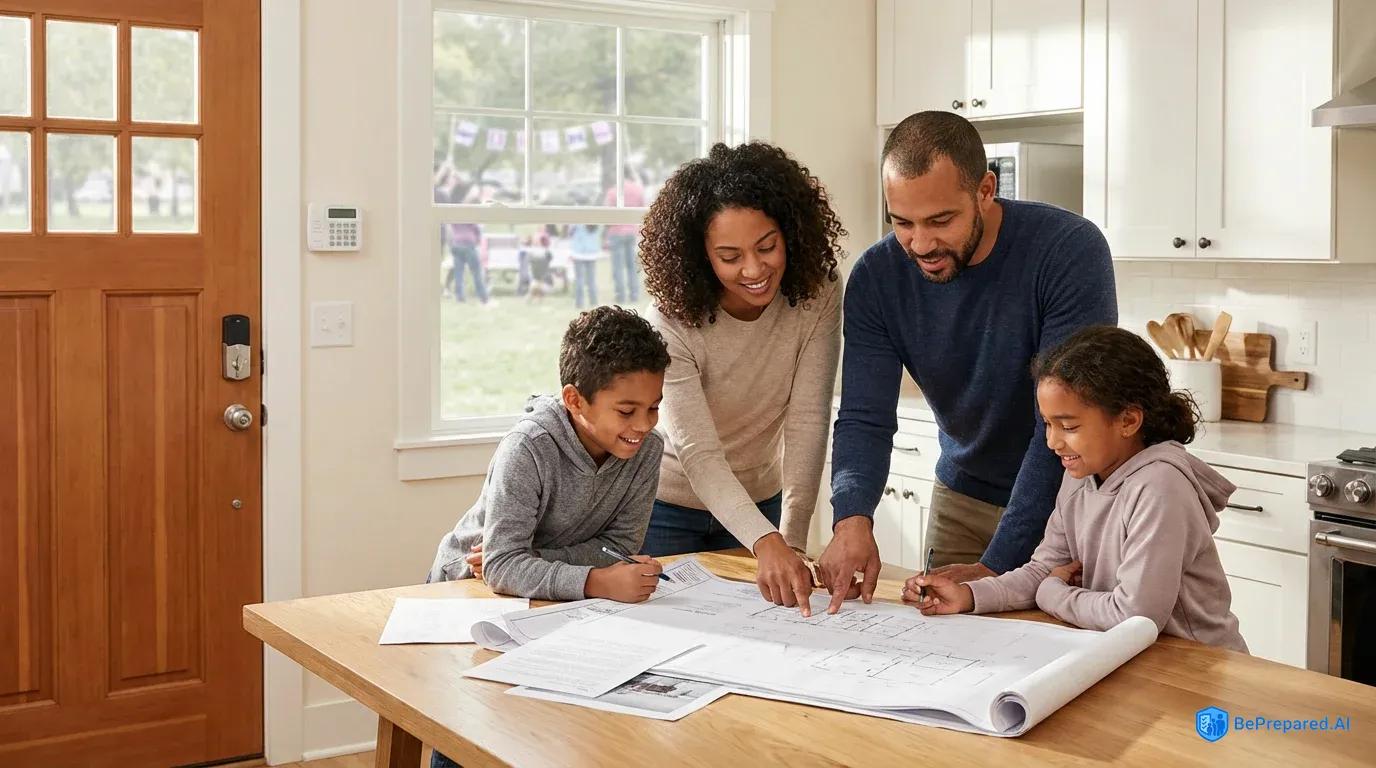
Before investing in security upgrades or developing response plans, you need a clear understanding of your home's current vulnerabilities. This assessment process might seem tedious, but it provides the foundation for every security decision that follows. Think of it as a home inspection, but instead of checking for termites or roof leaks, you're identifying the pathways an intruder might exploit during a crisis.
Step One: Conduct a perimeter walk-through during different times of day. Start at the street and approach your home as a stranger would. Walk the entire perimeter, noting every potential entry point. Most break-ins occur through first-floor windows and doors, which makes these your primary focus . However, don't overlook less obvious access points: basement windows, garage service doors, pet doors, and even second-story windows accessible via trees, trellises, or adjacent structures.
Take photos and notes on your phone—you'll reference these later when prioritizing improvements. Document everything, even features that seem secure at first glance. Your assessment should be comprehensive, not selective.
Pay particular attention to sight lines and concealment opportunities. That beautiful mature landscaping providing privacy from the street also provides cover for someone attempting to breach a window. The tall fence protecting your backyard creates a secluded workspace for intruders once they're past it. During your walk-through, identify areas where someone could work on an entry point without being visible from the street, neighboring properties, or your home's interior.
These concealed zones represent your highest-risk areas. Mark them clearly in your notes and prioritize them for security improvements.
Step Two: Evaluate each entry point's current security measures. Return to each door and window you identified and assess its defenses objectively. For doors, check the frame material and condition—even the best deadbolt is useless if the frame splinters with one kick. Examine the door itself: solid core or hollow? How many hinges? Are hinge pins exposed on the exterior? What's the deadbolt throw length?
For windows, note the lock type, frame material, and glass type. Single-pane windows offer minimal resistance, while double-pane or laminated glass significantly increases breach difficulty. Test each lock to ensure it functions properly and engages fully.
Don't forget to assess your garage, which often serves as the weakest link in home security. Garage doors can be surprisingly easy to compromise, and once inside the garage, intruders typically find an unlocked door into the house proper. Check your garage door opener security features, the integrity of door panels, and whether your service door meets the same standards as your home's other exterior doors.
Many homeowners invest heavily in front door security while leaving a flimsy hollow-core door between their garage and home. This creates a false sense of security that evaporates the moment someone targets your garage.
Step Three: Document valuable assets and create prioritized protection zones. Not every room in your home requires equal protection. Identify where you store items of significant monetary or sentimental value: jewelry, firearms, important documents, family heirlooms, electronics. Map these locations and consider whether consolidating valuables into a more defensible area makes sense.
This documentation serves dual purposes—it helps you design your security plan and provides crucial information for insurance claims if the worst occurs. Photograph high-value items and store this documentation off-site or in cloud storage.
Step Four: Complete a comprehensive risk assessment using systematic criteria. Create a simple scoring system for each entry point based on accessibility (how easy to reach), visibility (how concealed from observation), and current security level (existing protective measures). A ground-floor window hidden behind shrubs with a basic latch scores high risk. A second-story window visible from the street with a quality lock scores low risk.
This scoring helps you allocate limited resources to areas where they'll provide maximum benefit. Most homeowners can't afford to upgrade every entry point simultaneously, so prioritization becomes essential.
Consider external factors in your assessment as well. How far is your home from likely protest routes or commercial areas that might attract unrest? What's the typical law enforcement response time in your area during normal conditions—and how might that extend during widespread civil disorder? How visible is your home from neighboring properties, and what's your relationship with those neighbors?
These contextual factors influence your overall risk profile and should inform your security strategy. A home located near major thoroughfares faces different risks than one tucked into a quiet cul-de-sac.
Download our Home Security Assessment Checklist to ensure you don't overlook critical vulnerabilities and to maintain organized documentation of your security improvements over time.
Step Five: Reassess annually and after any home modifications. Your security needs evolve as your circumstances change. New landscaping, home additions, changes in neighborhood demographics, or modifications to nearby streets all impact your security profile. Schedule an annual reassessment, ideally in early spring when you can address any identified issues before summer months when civil unrest historically peaks.
This regular review ensures your security measures remain current and effective. Treat it like changing smoke detector batteries—a routine maintenance task that could save your home and family.
Essential Security Measures and Implementation
Translating your security assessment into actionable improvements requires understanding both the technical specifications of security hardware and the strategic principles governing their deployment. The goal is creating overlapping protective layers that delay, deter, and detect intrusion attempts while maintaining your home's livability and appearance.
Physical Barrier Enhancement
Physical barrier enhancement forms the foundation of your security infrastructure. Door reinforcement begins with the frame, not the lock. A standard residential door frame consists of a 1x4 jamb attached to the wall studs with finishing nails—a configuration that fails catastrophically under forceful entry attempts.
Install a door reinforcement kit that includes a strike plate extending at least three inches into the wall studs, secured with three-inch screws rather than the standard half-inch screws supplied with most locksets. Research shows that proper door reinforcement can increase break-in resistance by up to 300% . These kits distribute impact force across a much larger area and into structural framing rather than decorative trim, making forced entry significantly more difficult and time-consuming.
Upgrade to Grade 1 deadbolts with a minimum one-inch throw. The throw length determines how far the bolt extends into the strike plate—longer throws require more force to defeat. Ensure deadbolts feature hardened steel bolts and anti-saw pins. For doors with windows or located near windows, install double-cylinder deadbolts requiring keys from both sides, preventing intruders from breaking glass and reaching through to unlock the door.
Keep a key near but not within arm's reach of the window for emergency egress. Balance security with safety—you need to escape quickly during a fire.
Address hinge security on outswing doors by installing non-removable hinge pins or hinge bolts. Standard hinges become a liability when exposed on the exterior—removing three hinge pins is often easier than defeating a quality lock. Hinge bolts create an additional locking point that engages even if hinges are compromised, maintaining door integrity even when the primary hinge system fails.
Window security improvements vary based on window type and budget. Auxiliary locks provide inexpensive enhancement for sliding windows and double-hung windows, preventing opening even if the primary lock is defeated. Window security film, a polyester laminate applied to glass surfaces, won't prevent breakage but holds shattered glass in place, significantly delaying entry and creating noise that attracts attention.
Professional-grade security film can withstand repeated impacts that would completely breach untreated windows. The film creates a membrane that keeps glass fragments together, forcing intruders to spend considerably more time creating an opening large enough to climb through.
For high-risk windows identified in your assessment, consider polycarbonate shields or security bars. Modern security bars install on interior surfaces and feature quick-release mechanisms for emergency egress, addressing the safety concerns associated with traditional exterior bars. Polycarbonate shields provide impact resistance equivalent to security film while maintaining better clarity and requiring no ongoing maintenance.
These shields mount to window frames and can be removed when threats subside, offering flexibility that permanent installations lack.
Strategic Lighting Implementation
Strategic lighting implementation leverages the documented fact that proper illumination reduces criminal activity by 39% . However, effective security lighting requires more sophistication than simply installing bright floodlights. The objective is eliminating concealment opportunities while avoiding light pollution that antagonizes neighbors or creates dark adaptation issues that impair your own vision.
Layer your lighting approach with three distinct zones. Perimeter lighting establishes a continuous low-level illumination around your property boundary, eliminating deep shadows where intruders might stage or approach undetected. Motion-activated accent lighting at potential entry points provides sudden bright illumination when triggered, startling intruders and alerting you to activity.
Position motion sensors to cover approach paths rather than the entry points themselves—you want warning before someone reaches your door or window. This advance notice provides crucial seconds to assess the situation and respond appropriately.
Interior lighting automation creates occupancy illusions during your absence and provides illuminated escape routes during emergencies. Program lights on variable schedules that simulate realistic occupation patterns rather than predictable on-off cycles. During periods of civil unrest, maintain interior lighting that demonstrates presence without revealing specific locations or activities within your home.
Random variation in lighting patterns makes your home appear occupied even during extended absences. Smart home systems make this automation straightforward and affordable for most homeowners.
Surveillance System Deployment
Surveillance system deployment has become increasingly accessible with affordable IP camera systems offering capabilities that required professional installation and monitoring just a decade ago. Modern systems provide significant security enhancement, both as a deterrent and as documentation if incidents occur.
Position cameras to cover all primary entry points and high-risk zones identified in your assessment. Mount cameras at sufficient height to prevent easy tampering while angled to capture facial features rather than just overhead views. Ensure adequate lighting for nighttime recording—even cameras with infrared capability produce clearer images with ambient lighting.
Configure motion detection zones to minimize false alerts from trees, pets, or passing vehicles while capturing actual approach activity. Fine-tuning these zones takes patience but dramatically improves system usability.
Consider camera visibility carefully. Visible cameras deter opportunistic criminals but may be disabled by determined intruders during civil unrest when response times are extended. Some security professionals recommend a mixed approach: obvious cameras at main entry points for deterrence, plus concealed cameras providing backup documentation if primary cameras are compromised.
Ensure your recording system stores footage to local storage and cloud backup—local-only storage can be stolen or destroyed along with other property. Redundant storage protects your documentation even if intruders disable or remove equipment.
Safe Room Preparation
Safe room preparation provides a final defensive layer if intruders breach your exterior security. This doesn't require expensive construction—most homes can designate an existing interior room as a safe room with modest modifications. Ideal safe rooms lack windows, feature solid-core doors, and include communication capability.
Master bedroom closets, interior bathrooms, or basement utility rooms often work well. The room should be easily accessible from sleeping areas since many home invasions occur at night.
Reinforce the safe room door with the same techniques used for exterior doors: upgraded locks, reinforced frames, and solid construction. Stock the room with emergency supplies including water, first aid kit, flashlight, phone charger, and any critical medications. Install a keyed lock operable from inside, preventing intruders from trapping you but allowing you to secure the space.
Keep a charged cell phone or backup communication device in the safe room—during civil unrest, landlines may fail and your primary phone might be elsewhere when you need to shelter. Consider a battery-powered radio to monitor emergency broadcasts.
Document your safe room plan and ensure all household members understand when and how to use it. The safe room serves as a last resort if intruders enter your home—the goal is always preventing entry through your layered exterior security, but having a fortified interior position provides crucial protection if outer layers fail.
Practice accessing the safe room during drills so the process becomes automatic during high-stress situations. Muscle memory matters when seconds count.
Community Coordination and Response Plans
You could transform your home into an impenetrable fortress, but true security during civil unrest requires looking beyond your property line. The most sophisticated individual security measures pale compared to the protection offered by a coordinated, aware neighborhood. This isn't just theory—neighborhood watch programs reduce property crime by 16% during civil unrest, and that figure climbs significantly when communities move beyond passive observation to active coordination .
Building effective community security starts with knowing your neighbors, which sounds obvious but represents a challenge in many modern neighborhoods where people live parallel lives without genuine connection. Start small and personal rather than trying to organize a formal program immediately. Introduce yourself to the five or six homes immediately surrounding yours. Share phone numbers. Discuss general security concerns without being alarmist.
You're looking for people who share your interest in protecting the neighborhood and who you'd trust in a crisis situation. These core relationships form the foundation for broader community security efforts.
Once you've established these core relationships, consider expanding to a more structured neighborhood watch approach. Host a casual gathering—a backyard barbecue works better than a formal meeting for initial organization. Discuss recent crime trends, share security tips, and gauge interest in regular communication.
Many neighborhoods find that a private social media group or messaging app provides effective coordination without requiring formal meetings. The goal is creating a network where unusual activity gets reported and discussed quickly, where people watch each other's homes during absences, and where everyone knows they're not facing threats alone.
Develop clear communication protocols before they're needed. During civil unrest, normal communication channels may be overloaded or unavailable. Establish primary and backup contact methods: group text, dedicated messaging app, even old-school phone trees where each person contacts two others.
Create a simple code system for different alert levels—maybe "Code Yellow" means heightened awareness of protests in the area, while "Code Red" indicates direct threats to the neighborhood. These codes allow rapid information sharing without lengthy explanations during time-sensitive situations. Test your communication system periodically to ensure everyone understands the protocols.
Coordinate response strategies that respect individual capabilities and comfort levels. Not everyone is willing or able to patrol the neighborhood or directly confront suspicious activity, but everyone can contribute to collective security. Some neighbors might monitor security cameras and serve as communication hubs. Others might coordinate supply sharing or provide temporary shelter if someone's home is compromised.
Some might be willing to serve as first responders to disturbances while others focus on documenting incidents and communicating with authorities. The key is identifying roles before crisis strikes so everyone knows their responsibilities and can act without hesitation.
Create and distribute emergency contact lists that go beyond simple phone numbers. Include information about household composition (particularly children, elderly, or disabled residents who might need assistance), critical medical conditions, pet ownership, and special skills or resources individuals can contribute. Note which neighbors have generators, medical training, firearms, security systems, or other relevant capabilities.
Update this information quarterly and ensure every participating household maintains current copies in multiple formats—digital and printed. Paper copies remain accessible when power and internet fail.
Practice your coordination plan with periodic drills or exercises. This doesn't mean running tactical scenarios through the neighborhood, but perhaps testing your communication network by having everyone check in within a specified timeframe, or conducting a walking assessment of neighborhood security with interested participants.
These exercises identify gaps in your planning, build familiarity with procedures, and strengthen community bonds. They also reveal practical problems—like discovering that half your neighbors have their phones on silent at night—before those problems become critical during actual emergencies.
Remember that effective community security during civil unrest requires balancing vigilance with restraint. The goal is protecting your neighborhood, not creating conflict or escalating tensions. Establish clear guidelines about when to observe and report versus when to directly intervene.
Generally, property crimes warrant observation and documentation rather than confrontation, while immediate threats to personal safety may require direct response. Coordinate with local law enforcement before civil unrest occurs, understanding their expectations for community watch activities and establishing reporting procedures. Many police departments offer neighborhood watch training that clarifies legal boundaries and best practices.
Weighing the Pros and Cons of Community Security Coordination
Advantages:
- Multiplies surveillance coverage across the entire neighborhood
- Distributes security costs and responsibilities among multiple households
- Provides mutual aid and support during extended emergencies
- Creates social connections that enhance daily quality of life
- Establishes communication networks useful for all types of emergencies
- Deters criminal activity through visible community cohesion
Disadvantages:
- Requires ongoing time investment to maintain relationships and systems
- Depends on neighbor participation that may wane over time
- Can create liability concerns if coordination leads to confrontations
- May expose personal information to neighbors you don't fully trust
- Risks vigilante behavior if guidelines aren't clear and followed
- Can generate neighborhood politics and interpersonal conflicts
Your community coordination efforts provide benefits extending far beyond civil unrest scenarios. The relationships you build and systems you establish enhance everyday security, create more resilient neighborhoods during natural disasters, and foster the kind of community connection that makes neighborhoods genuinely desirable places to live.
When civil unrest does occur, you'll face it not as isolated individuals but as a coordinated community—a transformation that fundamentally changes the security equation in your favor. The investment in building these relationships pays dividends across every aspect of neighborhood life, from borrowed tools to shared celebrations to collective safety.
Taking Action Before Crisis Strikes
The difference between homes that weather civil unrest intact and those that suffer damage often comes down to preparation completed before tensions escalate. Your security assessment identifies vulnerabilities. Your physical improvements create defensive layers. Your community coordination multiplies your protective capabilities.
Start with your highest-risk entry points identified during assessment. Reinforce those doors and windows first, then work systematically through lower-priority areas as budget allows. Implement lighting improvements that provide immediate deterrent value at modest cost. Establish neighbor relationships that cost nothing but time and goodwill.
Document everything: your security improvements, your emergency supplies, your community contacts, your insurance coverage. Store this documentation both at home and off-site. When crisis strikes, you won't have time to gather information or make complex decisions. Your preparation allows you to execute plans rather than improvise under pressure.
Review and update your security measures annually. Technology improves, neighborhoods change, and your family's needs evolve. What worked last year may need adjustment this year. Treat home security as an ongoing process rather than a one-time project.
The homes that survive civil unrest intact share common characteristics: multiple security layers, engaged owners who prepared in advance, and connection to coordinated communities. You can create these same characteristics for your home, starting today. The question isn't whether civil unrest might affect your neighborhood—the data shows it's a matter of when, not if. The question is whether you'll face that eventuality prepared or vulnerable.
Your home represents more than property—it's where your family builds memories, finds refuge, and creates their lives. Protecting it during civil unrest isn't paranoia. It's responsible stewardship of what matters most.