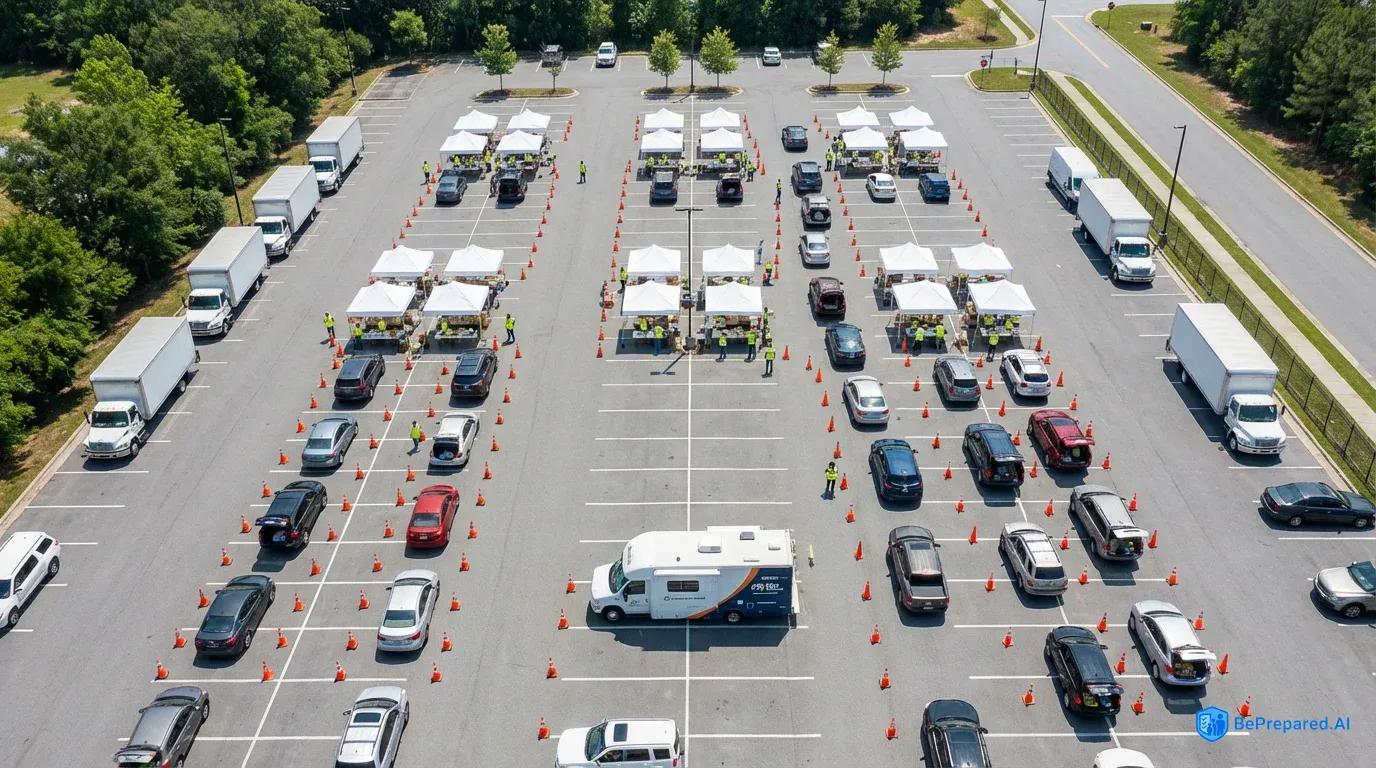
Understanding Community-Scale Food Distribution Systems
When Hurricane Maria devastated Puerto Rico in 2017, the island's centralized food distribution system collapsed within days. Supermarket shelves emptied, supply chains fractured, and thousands of residents faced food scarcity. The communities that fared best weren't necessarily those with the most resources—they were the ones that had established decentralized, community-scale distribution networks before disaster struck. This stark example illustrates a fundamental truth about emergency preparedness: the difference between surviving and thriving during a crisis often comes down to having robust food distribution systems already in place.
Understanding the mechanics of community-scale food distribution begins with recognizing how fundamentally different emergency distribution is from normal commercial supply chains. In ordinary times, food flows through a complex web of producers, processors, distributors, and retailers, each optimized for efficiency and profit margins. This system works brilliantly when infrastructure remains intact and fuel flows freely. During civil unrest, natural disasters, or widespread infrastructure failures, this delicate network can disintegrate rapidly.
Emergency distribution systems must operate under entirely different assumptions: damaged roads, limited fuel, compromised communication networks, and potentially hostile or chaotic environments. Where commercial distribution prioritizes cost-effectiveness, emergency systems prioritize resilience, redundancy, and rapid deployment capability. The operational parameters shift from just-in-time delivery to buffer stock maintenance, from centralized warehousing to distributed caching, from predictable demand patterns to surge capacity requirements.
Scale Considerations and Resource Requirements
The scale considerations for community food distribution are staggering when you examine the numbers. A properly staffed Point of Distribution (POD) can serve up to 20,000 people per day, but achieving this throughput requires meticulous planning and substantial resources . Consider what this means in practical terms: if your community has 50,000 residents, you need at least three fully operational PODs to ensure everyone receives supplies within a single day. Each of these distribution points becomes a critical node in your community's survival infrastructure.
The planning complexity multiplies when you factor in population density variations, transportation limitations, and the reality that not every resident can easily travel to distribution points. Elderly residents, those with disabilities, and families with young children face mobility challenges that your system must accommodate. Geographic barriers—rivers, highways, railroad tracks—can effectively partition your community into distinct service zones, each requiring dedicated distribution infrastructure.
Resource requirements for emergency food distribution extend far beyond simply stockpiling supplies. Urban areas require 2.2 pounds of food per person per day for emergency planning purposes . This figure accounts for nutritional needs, waste, and the reality that emergency rations must provide adequate calories for people who may be performing physically demanding recovery work. For a city of 100,000 people, this translates to 110 tons of food daily—220,000 pounds that must be stored, transported, inventoried, and distributed efficiently.
The sheer volume challenges most communities' logistical capabilities. You need warehousing space with proper environmental controls, transportation vehicles capable of moving bulk supplies, and tracking systems to prevent spoilage or theft. Temperature-sensitive items like dairy products, fresh produce, and certain medications require refrigerated storage and cold-chain transportation. Dry goods need protection from moisture, pests, and contamination. The diversity of storage requirements complicates facility design and increases infrastructure costs.
The infrastructure supporting these resource requirements must be equally robust. Storage facilities need backup power systems to maintain temperature-controlled environments for perishable items. Distribution points require adequate space for both supply staging and the queuing of recipients, often necessitating parking lots, community centers, or school gymnasiums. Water access becomes critical, both for sanitation and for preparing certain emergency rations. Security considerations cannot be overlooked—concentrated food supplies attract desperate people, and distribution points may require controlled access and crowd management protocols.
Personnel requirements represent another substantial resource consideration. Each distribution point requires minimum 19-person staff for basic operations, and this assumes trained volunteers who understand their roles . These teams need specialists in inventory management, crowd control, needs assessment, and logistics coordination. Training these individuals before an emergency occurs proves essential because learning during a crisis leads to costly errors and dangerous delays.
The human element extends beyond the distribution teams themselves—you need coordinators who understand the broader system, communicators who can interface with the public, and decision-makers who can adapt plans as situations evolve. Specialized roles include security personnel to maintain order, medical staff to identify health emergencies among recipients, and translators to serve non-English-speaking populations. Each role requires specific training, clear responsibilities, and backup personnel who can assume duties when primary staff become unavailable.
The financial resources required for establishing community-scale distribution systems often surprise even experienced planners. Beyond the obvious costs of food stockpiles, communities must invest in storage infrastructure, transportation assets, communication equipment, and training programs. Many successful community distribution systems operate on public-private partnerships, leveraging existing commercial infrastructure during emergencies while maintaining dedicated emergency-only resources for critical components.
This hybrid approach reduces upfront costs while maintaining the redundancy essential for true resilience. The investment pays dividends not just during major disasters but also during smaller-scale disruptions when having established distribution networks can prevent localized shortages from cascading into community-wide crises. Budget planning should account for recurring costs—equipment maintenance, supply rotation to prevent expiration, ongoing training programs, and periodic system testing—that continue year after year regardless of whether emergencies occur.
Distribution Network Design and Infrastructure
The architecture of your distribution network determines whether your community can maintain food security during extended disruptions or descends into chaos within days. The hub-and-spoke model has emerged as the gold standard for emergency food distribution, and understanding why requires examining both its elegance and its practical advantages. In this configuration, a central hub receives bulk shipments, maintains primary inventory, and coordinates distribution to satellite locations—the spokes—which serve as community access points.
This design mirrors successful commercial logistics networks but incorporates the redundancy and flexibility essential for emergency operations. The hub-and-spoke topology allows efficient resource allocation, centralized decision-making, and standardized procedures while maintaining distributed access points that serve local populations. The model scales effectively from small towns to major metropolitan areas by adjusting the number of spokes and the capacity of hub facilities.
The hub facility serves as your system's nerve center and primary warehouse. Ideally located near major transportation routes but protected from common hazard zones like flood plains or earthquake fault lines, the hub needs substantial square footage—typically 20,000 to 50,000 square feet for communities of 50,000 to 200,000 people. This space accommodates bulk storage, staging areas for outbound shipments, administrative functions, and equipment maintenance.
The hub's location should offer multiple access routes, ensuring that damage to any single road or bridge doesn't isolate your primary facility. Many communities successfully utilize existing commercial warehouses or distribution centers for this purpose, establishing memorandums of understanding with facility owners that allow emergency commandeering during declared disasters. Site selection criteria should include ceiling height adequate for pallet racking systems, loading dock capacity for simultaneous truck operations, and floor load ratings sufficient for heavy equipment and stacked supplies.
Spoke locations—the actual Points of Distribution where residents receive supplies—require different characteristics than the hub. Communities should establish distribution hubs every 5-7 miles in urban areas to ensure reasonable access for residents traveling on foot or bicycle . This spacing recognizes that during infrastructure failures, many people cannot drive to distribution points, either because their vehicles are damaged, fuel is unavailable, or roads are impassable.
Schools, community centers, fire stations, and churches often make excellent spoke locations because they're familiar landmarks, already serve community gathering functions, and typically have parking areas suitable for queuing and distribution operations. The most resilient networks identify multiple potential spoke locations in each geographic zone, allowing rapid activation of alternative sites if primary locations become compromised. Site assessment should evaluate parking capacity, covered areas for weather protection, restroom facilities, and proximity to vulnerable populations who most need accessible services.
Urban versus rural considerations fundamentally alter network design approaches. Urban distribution networks benefit from population density—each spoke location can serve thousands of residents within a small geographic radius. Urban environments present challenges: higher population density means faster resource depletion, traffic congestion can hamper distribution vehicle movement, and the concentration of people at distribution points creates security concerns.
Urban planners must account for vertical density in apartment buildings and high-rises, potentially establishing distribution points within large residential complexes rather than expecting residents to travel to centralized locations. The infrastructure already exists in cities—the challenge lies in adapting it for emergency use and ensuring redundancy. Multi-story buildings require special consideration for moving supplies vertically when elevators fail, potentially necessitating ground-floor distribution points or manual carrying teams.
Rural distribution networks face opposite challenges. Lower population density means spoke locations must cover larger geographic areas, increasing transportation requirements and fuel consumption. A 5-7 mile spacing that works in cities becomes impractical in rural areas where residents might live 20-30 miles from the nearest town. Rural networks often employ mobile distribution units—trucks equipped to serve as temporary PODs—that travel to communities too small to justify permanent spoke locations.
These mobile units operate on scheduled routes, similar to bookmobile services, ensuring even isolated residents receive regular access to supplies. The trade-off is that rural distribution requires more vehicles, more fuel reserves, and more complex coordination than urban systems. Route planning must account for seasonal road conditions, particularly in regions experiencing winter weather that can render secondary roads impassable for extended periods.
Redundancy planning separates functional distribution networks from truly resilient ones. Research indicates that decentralized distribution networks showed 47% higher resilience during civil unrest scenarios compared to centralized systems . This statistic reflects a crucial principle: single points of failure create catastrophic vulnerabilities. Your network design must assume that any component—hub facilities, spoke locations, transportation routes, or personnel—might become unavailable.
Practical redundancy means identifying backup hub facilities in different parts of your service area, pre-positioning emergency supplies at multiple locations rather than concentrating them at a single warehouse, and cross-training personnel so that critical functions don't depend on specific individuals. Strategic supply caching places smaller stockpiles at spoke locations or secure intermediate facilities, ensuring that hub facility compromise doesn't eliminate all available resources.
The concept of layered redundancy extends beyond simple backups. Consider transportation infrastructure: your primary distribution routes should have at least two alternatives, ideally using different types of roads or crossing different bridges. If your main route uses the interstate highway, alternatives might use state highways and local roads. This diversity ensures that the same event—say, an earthquake damaging highway overpasses—doesn't simultaneously compromise all your distribution routes.
Similarly, spoke locations should have primary and secondary sites in each service zone. If your primary POD is a high school, your secondary might be a nearby park or parking lot that can be quickly converted to distribution use. Tertiary options provide additional fallback positions when both primary and secondary sites prove unusable.
Geographic information systems (GIS) technology has revolutionized distribution network design, allowing planners to model various scenarios and optimize spoke placement. These systems can overlay population density data, transportation networks, hazard zones, and existing infrastructure to identify optimal hub and spoke locations. More sophisticated applications simulate disaster scenarios, showing how network performance degrades as specific components fail and identifying critical vulnerabilities.
Communities investing in professional network design increasingly rely on these analytical tools, which can reveal non-obvious optimization opportunities that intuitive planning might miss. The software can calculate precise service areas for each spoke location, ensuring no population clusters fall into coverage gaps. Advanced modeling incorporates demographic data to identify concentrations of vulnerable populations requiring special accommodation, traffic flow patterns to predict congestion points, and historical hazard data to avoid high-risk locations.
Physical infrastructure at distribution points requires careful specification. Each spoke location needs covered space for supplies protected from weather, open areas for vehicle circulation and recipient queuing, adequate lighting for operations extending into evening hours, and access to utilities—particularly electricity and water. Many successful PODs employ modular infrastructure that can be rapidly deployed: pop-up canopies for weather protection, portable generators for power, and temporary fencing for crowd management.
This approach allows communities to activate distribution points at locations that might lack permanent infrastructure, significantly expanding the number of potential spoke sites. The trade-off is that modular infrastructure requires storage, transportation, and setup time—factors that must be incorporated into activation timelines. Equipment inventories should include backup components for critical items, recognizing that canopy frames bend, generators fail, and fencing sections go missing.
- Security Infrastructure
- Perimeter requirements, access control systems, and guard posts scaled by facility size and threat assessment
- Storage Capacity Metrics
- Square footage per supply category: Dry goods, perishables, medical supplies, with turnover rate calculations
- Communications Systems
- Redundant comms infrastructure requirements: Radio networks, satellite backup, mesh networks by facility scale
Logistics and Resource Management
The logistics of moving thousands of pounds of food daily from storage to distribution points and ultimately into the hands of community members represents one of the most complex challenges in emergency preparedness. Success requires systems thinking—viewing the entire operation as an interconnected whole where efficiency in one area enables effectiveness throughout the network. The foundation of these logistics begins with inventory tracking systems that provide real-time visibility into what supplies exist, where they're located, and how quickly they're being consumed.
Modern inventory management for emergency distribution has evolved far beyond clipboards and spreadsheets, though these backup methods remain essential when digital systems fail. Digital inventory systems can significantly reduce distribution errors compared to manual tracking methods , a benefit that reflects both improved accuracy and enhanced decision-making capability. These systems typically employ barcode or RFID scanning technology, allowing warehouse staff to log incoming shipments, track storage locations, and record outbound distributions with simple scans.
The data flows into centralized databases accessible to coordinators throughout the network, providing real-time visibility into supply levels at every location. When a spoke location reports dwindling supplies of a critical item, hub managers can immediately identify available stock and dispatch resupply vehicles. Automated alerts notify coordinators when inventory levels fall below predetermined thresholds, enabling proactive resupply before stockouts occur.
Implementation of digital inventory systems requires upfront investment but pays continuous dividends. Start by selecting software designed specifically for emergency management or humanitarian logistics rather than adapting commercial retail systems. Purpose-built platforms understand the unique requirements of disaster distribution: rapid deployment, operation in degraded infrastructure environments, offline functionality with periodic synchronization, and integration with resource request systems used by emergency management agencies.
Training staff on these systems before emergencies occur proves essential—during a crisis is not the time to learn new software. Conduct regular exercises where teams practice receiving shipments, updating inventory, and processing distribution requests using the actual systems they'll employ during emergencies. Proficiency develops through repetition, and muscle memory established during training exercises carries over into high-stress operational environments.
Transportation coordination represents the circulatory system of your distribution network, moving supplies from hubs to spokes and sometimes directly to individuals unable to reach distribution points. Mobile distribution units should maintain 72-hour fuel reserves to ensure operational continuity when commercial fuel supplies become unavailable . This requirement means more than just keeping vehicle tanks full—it necessitates dedicated fuel storage at your hub facility, preferably in underground tanks that protect fuel from temperature extremes and potential theft.
Calculate fuel requirements by determining the round-trip distance from your hub to each spoke location, multiplying by the number of daily resupply runs expected during peak operations, and adding a 30% reserve for unexpected detours or additional missions. Fuel consumption calculations should account for loaded versus unloaded vehicle weight, as fully loaded trucks consume significantly more fuel than empty returns.
Vehicle selection significantly impacts distribution efficiency. Box trucks in the 16-24 foot range offer optimal balance between cargo capacity and maneuverability, particularly in urban environments where large tractor-trailers struggle with tight turns and residential streets. These vehicles can carry 3,000-5,000 pounds of supplies—enough to stock a spoke location serving several hundred people daily—while remaining nimble enough to navigate damaged infrastructure.
Communities should maintain a mixed fleet including at least one larger vehicle for bulk hub-to-spoke transfers and several smaller vehicles for specialized missions like home delivery to immobile residents. Four-wheel-drive capability becomes essential in regions experiencing winter weather or off-road travel requirements. Lift gates or ramps facilitate loading and unloading when dock facilities aren't available, a common situation at improvised distribution points.
Establishing a vehicle maintenance protocol ensures transportation assets remain operational when needed most. Disasters don't announce themselves with convenient timing—your distribution vehicles might sit unused for months or years before suddenly becoming critical to community survival. Monthly start-ups and brief operational runs prevent battery degradation and identify mechanical issues before they become critical failures.
Maintain relationships with local mechanics who can provide emergency repair services, ideally securing written agreements for priority service during disasters. Stock critical spare parts that might become unavailable during widespread emergencies: batteries, alternators, fuel pumps, and tires sized for your specific vehicles. Preventive maintenance schedules should follow manufacturer recommendations, with documentation systems tracking service history for each vehicle in your fleet.
Staffing considerations for logistics operations extend beyond the 19-person minimum required for basic POD operations. Your hub facility needs dedicated logistics coordinators who manage the overall supply flow, inventory specialists who maintain tracking systems, warehouse workers who physically move supplies, and transportation coordinators who dispatch vehicles and plan routes. Each spoke location requires receiving personnel who can accept deliveries, verify shipments against manifests, and update inventory systems.
During peak operations, these roles demand full-time attention—you cannot expect people to simultaneously manage logistics and perform distribution functions effectively. Shift scheduling becomes critical during extended operations, ensuring adequate rest periods to prevent fatigue-related errors. Cross-training allows personnel to rotate between positions, maintaining operational tempo even when specific individuals become unavailable.
Developing standard operating procedures (SOPs) for every logistics function creates consistency and reduces errors, particularly when volunteers or mutual aid personnel supplement your core team. These procedures should detail how to receive shipments, where to store different supply categories, how to prepare outbound loads, and what documentation to maintain. Visual aids—photographs showing proper pallet stacking, diagrams illustrating storage zone layouts, and flowcharts depicting decision processes—make SOPs accessible even to personnel with limited experience.
Laminate key procedures and post them prominently in work areas where staff can reference them without searching through binders or digital files. Job aids—quick-reference cards summarizing critical steps for specific tasks—provide at-a-glance guidance during high-tempo operations when consulting full procedures isn't practical.
Resource allocation decisions test logistics managers' judgment constantly during extended emergencies. When supplies run short, how do you prioritize distribution among spoke locations? When special needs arise—infant formula for a family with a newborn, diabetic-appropriate foods for insulin-dependent residents—how do you source and deliver specialized items? These scenarios require pre-established decision frameworks that balance equity, urgency, and available resources.
Many successful distribution systems employ tiered priority schemes: immediate life-threatening needs receive highest priority, followed by vulnerable populations (elderly, disabled, families with young children), then general population on a first-come, first-served basis. Document these frameworks before crises occur, ensuring all staff understand the principles guiding allocation decisions. Ethical considerations become particularly acute when demand exceeds supply, requiring transparent criteria that the community perceives as fair even when outcomes disappoint some recipients.
Communication and Coordination Systems
The most sophisticated distribution network fails without robust communication systems connecting all its components. Information must flow constantly in multiple directions: from spoke locations reporting supply levels to hub coordinators, from hub managers dispatching resupply vehicles to drivers, from incident commanders making strategic decisions to operational teams implementing them, and from distribution points to the public announcing hours, locations, and available supplies.
This complex information ecosystem requires redundant communication systems, clear protocols, and trained personnel who understand both the technology and the organizational structures it supports. Communication failures during emergencies typically stem not from equipment malfunction but from inadequate planning, insufficient training, or unclear procedures that break down under stress.
Radio communication forms the backbone of emergency distribution networks because it functions independently of commercial infrastructure that often fails during disasters. Effective distribution requires minimum 2-way radio coverage within a 25-mile radius, ensuring that hub facilities, spoke locations, and mobile distribution units can maintain constant contact . This specification demands professional-grade radio systems operating in VHF or UHF frequency ranges, not consumer-grade walkie-talkies with their limited range and reliability.
Communities should secure appropriate FCC licenses for dedicated emergency frequencies, preventing interference from other users and ensuring legal operation during both exercises and actual emergencies. Licensing processes can take months, making advance planning essential. Frequency coordination with neighboring jurisdictions prevents interference and enables interoperability when mutual aid resources arrive from surrounding communities.
Building out radio infrastructure requires technical expertise and significant investment. Base stations at hub facilities need high-gain antennas mounted at elevation—rooftop installations or dedicated towers—to maximize coverage area. Each spoke location requires either a mobile radio (higher power than handheld units) or a base station if the location will serve as a long-term distribution point. Mobile distribution vehicles need vehicle-mounted radios with external antennas, providing far superior range compared to handheld units.
Handheld radios serve as backup communication devices and for use by personnel moving within distribution sites. Calculate quantities by ensuring every team leader and coordinator has a dedicated radio, plus 20% additional units for replacements and new personnel. Battery management becomes critical—maintain charging stations at all facilities and stock spare battery packs to enable continuous operations during extended shifts.
Communication protocols prevent radio channels from descending into chaos during high-tempo operations. Establish clear call signs for each location and role: "Distribution Hub" for your main facility, "POD-North," "POD-South," etc. for spoke locations, and "Transport-1," "Transport-2" for distribution vehicles. Train all radio users on proper procedures: identifying themselves before transmitting, keeping messages concise and relevant, using clear language rather than unclear codes, and acknowledging received messages.
Designate primary and secondary frequencies, using the primary for operational communications and the secondary for coordination among leadership. This separation prevents routine logistics chatter from interfering with strategic decision-making communications. Establish radio discipline through training and enforcement—undisciplined radio use degrades system effectiveness for all users.
Digital communication systems complement radio networks when infrastructure permits. Establish a distribution network email group or messaging platform that connects all coordinators, allowing rapid dissemination of policy updates, supply information, and operational changes. Cloud-based collaboration platforms enable real-time updates to shared documents—supply inventories, distribution schedules, contact lists—that all team members can access.
Design these digital systems with the assumption that they will fail. Every critical function supported by digital communication must have an analog backup: printed contact lists, paper forms for inventory tracking, and physical bulletin boards for posting updates at distribution sites. Redundancy in communication systems isn't optional—it's the difference between maintaining coordination during infrastructure failures and descending into isolated, uncoordinated operations.
Command structure clarity prevents the confusion that paralyzes decision-making during crises. Your distribution network should integrate into your community's broader emergency management structure, typically following the Incident Command System (ICS) used by professional emergency responders. The distribution network manager reports to the logistics section chief within the ICS structure, coordinating with other functions like transportation, communications, and resource tracking.
Within the distribution network itself, establish clear authority lines: hub managers oversee central operations and make supply allocation decisions, spoke coordinators manage individual POD operations and report supply needs, and transportation coordinators dispatch vehicles and manage the fleet. Document these relationships in organizational charts that show both normal reporting lines and succession plans when primary personnel become unavailable. Delegation of authority protocols specify who can make what decisions, preventing bottlenecks when senior leaders become overwhelmed or unreachable.
Regular coordination meetings maintain information flow and enable collaborative problem-solving. During active distribution operations, brief daily coordination calls connect hub managers, spoke coordinators, and transportation leads, allowing each to report status, request support, and raise issues. These meetings need not be lengthy—15-20 minutes suffices when participants come prepared with concise updates.
Establish a standard agenda: supply status, operational issues, resource requests, and next 24-hour priorities. Rotate meeting leadership among coordinators to build capability throughout the team and prevent single-point dependencies on specific individuals. Document meeting outcomes and distribute action items with assigned responsibilities and deadlines, ensuring decisions translate into executed tasks.
Public communication represents the external face of your distribution network, informing community members about available services and managing expectations during challenging circumstances. Designate a public information officer responsible for crafting and disseminating public messages through multiple channels: local radio announcements, social media posts, printed flyers distributed throughout the community, and signage at distribution points.
Messages should specify POD locations, operating hours, what items are available, what identification or documentation recipients need, and any special accommodations for vulnerable populations. Update this information regularly as situations evolve—nothing frustrates desperate people more than traveling to a distribution point only to discover it's closed or out of critical supplies. Message consistency across all channels prevents confusion and builds public trust in your distribution system.
Establishing feedback mechanisms allows the public to communicate needs, report problems, and request assistance. A dedicated phone line or email address for distribution inquiries, monitored by trained staff, provides a release valve for frustrations and an intelligence source about emerging issues. Track common questions and complaints, using this data to improve operations and anticipate problems.
When multiple callers report confusion about POD locations, you know your wayfinding signage needs improvement. When several people request accommodations for mobility limitations, you can proactively establish special service hours or home delivery programs. Feedback analysis transforms individual complaints into actionable intelligence that drives system improvements.
Implementation and Testing Protocols
The gap between planning and operational readiness closes only through rigorous testing and continuous improvement. Communities that have never activated their distribution networks during actual emergencies often discover critical flaws when disaster strikes—missing equipment, untrained personnel, incompatible systems, or simply plans that look elegant on paper but prove unworkable in practice. Systematic testing protocols identify these vulnerabilities while stakes remain low, allowing refinement before lives depend on flawless execution.
Dry run procedures should simulate actual emergency conditions as realistically as possible while maintaining safety and managing costs. Begin with tabletop exercises where coordinators and key personnel gather to walk through scenarios verbally, discussing how they would respond to various situations. These low-cost exercises test decision-making processes, reveal gaps in plans or authorities, and build familiarity with procedures.
A facilitator presents a scenario—perhaps a severe winter storm has cut power and closed roads throughout the region—and asks participants to describe their actions step by step. "The hub manager reports that the backup generator failed to start. What's your response?" These discussions uncover assumptions, dependencies, and potential failure points that might not be obvious from reading plans. Tabletop exercises work particularly well for introducing new personnel to the distribution system and for testing modifications to existing procedures.
Progress from tabletop exercises to functional exercises that activate portions of your distribution system. Set up a single POD and practice receiving, inventorying, and distributing supplies to volunteer "recipients." These exercises test physical processes: Can your team actually unload a pallet of supplies and set up distribution tables in the time you've allocated? Do you have enough tables, chairs, and equipment? Are your inventory forms clear and usable?
Functional exercises reveal practical problems that tabletop discussions miss. You might discover that the folding tables you planned to use are too flimsy for heavy supply boxes, or that your chosen POD location lacks adequate electrical outlets for lighting and equipment. Physical execution exposes planning assumptions that don't survive contact with reality.
Full-scale exercises activate your entire distribution network, from hub through all spoke locations, testing coordination and communication under realistic conditions. These comprehensive exercises require significant planning and resources—you're essentially conducting a real distribution operation without an actual emergency. Regular testing can substantially reduce deployment time, reflecting both improved individual proficiency and enhanced system-level coordination .
Communities that test quarterly or less frequently never achieve the muscle memory and organizational rhythm that frequent exercises develop. Schedule these full-scale exercises during different seasons and times of day to test performance under varied conditions. A summer afternoon exercise won't reveal the challenges of operating in winter darkness or how rain affects outdoor distribution operations. Seasonal variation testing ensures your system functions regardless of when disaster strikes.
Performance metrics transform subjective assessments into objective data that drives improvement. Establish specific, measurable targets for critical functions: time from activation order to first POD opening, number of people served per hour at each spoke location, inventory accuracy rates, and communication response times. During exercises, assign observers to track these metrics systematically.
How long did it actually take to set up the POD? Count the number of recipients served each hour. Review inventory records after the exercise to identify discrepancies. These measurements provide baseline data for comparison across multiple exercises, revealing whether your system is improving or degrading over time. Trend analysis identifies which improvements yield measurable results and which interventions fail to move performance metrics.
After-action reviews (AARs) convert exercise experiences into institutional learning. Conduct AARs within 48 hours of exercise completion while details remain fresh in participants' memories. Gather all key personnel—hub managers, spoke coordinators, transportation leads, and frontline workers—and systematically review what happened. Structure the discussion around four questions: What was supposed to happen? What actually happened? Why were there differences? What will we do differently next time?
Encourage honest, blame-free discussion. The goal is identifying system improvements, not criticizing individuals. Document findings and assign specific people to address each identified issue before the next exercise. AAR documentation becomes institutional memory, preventing the same problems from recurring across multiple exercises and ensuring that hard-won lessons translate into procedural improvements.
Standardized training can substantially reduce distribution errors compared to operations relying on untrained or informally trained personnel . This improvement reflects the power of consistent procedures and shared understanding across your team. Develop formal training curricula for each role within your distribution network: hub managers, spoke coordinators, inventory specialists, distribution workers, and transportation personnel.
These curricula should combine classroom instruction covering concepts and procedures with hands-on practice performing actual tasks. New hub managers should practice using your inventory system, making allocation decisions, and coordinating with spoke locations before they're expected to perform these functions during an emergency. Skills-based training ensures personnel can execute procedures under stress, not just understand them intellectually.
Training programs need regular updates reflecting lessons learned from exercises and actual operations. After each major exercise, review training materials to identify gaps. If multiple personnel struggled with a specific procedure, your training probably doesn't adequately cover that topic. When you implement new equipment or modify procedures, update training immediately and schedule refresher sessions for existing personnel.
Maintain training records documenting who has completed which curricula and when, allowing you to identify personnel needing refresher training or new staff requiring initial qualification. Training management systems track individual qualifications, alert supervisors when recertification deadlines approach, and generate reports showing overall team readiness levels.
Certification programs formalize training and create accountability. Rather than assuming someone is qualified because they attended training, establish practical assessments that personnel must pass to be certified for specific roles. A hub manager certification might require successfully managing a simulated distribution operation, demonstrating proficiency with inventory systems, and making sound allocation decisions during scenario-based exercises.
These certifications ensure minimum competency standards while identifying high-performers who can mentor others or take on expanded responsibilities. Require periodic recertification—annually or biannually—to maintain skills and stay current with evolving procedures. Certification programs create professional development pathways that motivate volunteers and paid staff to invest in skill development.
System optimization emerges from the continuous cycle of testing, measurement, analysis, and refinement. Each exercise generates data about your network's performance. Analyze this data systematically, looking for patterns and trends. If POD setup times have plateaued despite continued training, perhaps you've reached the limits of your current procedures and need to redesign workflows.
If certain spoke locations consistently underperform compared to others, investigate whether they face unique challenges requiring different approaches. The most successful distribution networks treat optimization as an ongoing process rather than a destination, constantly seeking incremental improvements that compound over time. Continuous improvement methodologies borrowed from manufacturing and logistics industries apply equally well to emergency distribution systems.
Scaling considerations ensure your system can expand to meet larger-than-anticipated demands. Design exercises that progressively increase stress on your network: more recipients than expected, longer operational periods, or multiple PODs failing simultaneously. These stress tests reveal your system's breaking points and capacity limits. Can your hub supply three additional spoke locations beyond what you've planned? What happens when a distribution operation must continue for weeks rather than days?
Understanding these limits allows you to identify the additional resources—supplies, personnel, equipment—needed to expand operations when circumstances demand. Scalability planning identifies which system components constrain expansion and what investments would remove those bottlenecks.
The investment in comprehensive testing and training programs pays dividends that extend beyond emergency preparedness. Communities discover that the relationships built, skills developed, and systems established for food distribution prove valuable during non-emergency situations. The same networks that would distribute emergency rations can support community food banks, coordinate donations for families facing hardship, or organize neighborhood mutual aid.
The organizational capacity you build for crisis response becomes a community asset that generates ongoing value, justifying the substantial commitment of time and resources that truly resilient distribution systems require. This dual-use approach—systems designed for emergencies but employed for routine community support—maintains operational readiness while providing tangible peacetime benefits that sustain political and financial support for emergency preparedness programs.
Transform your community's emergency preparedness with our comprehensive Community Distribution System Planning Template. This professional resource provides detailed worksheets, implementation checklists, and planning tools that guide you through designing, implementing, and testing a robust food distribution network. Access inventory calculation tools, facility assessment guides, and training curricula proven effective in successful community distribution programs nationwide. Download now and begin building the resilient distribution infrastructure your community needs.