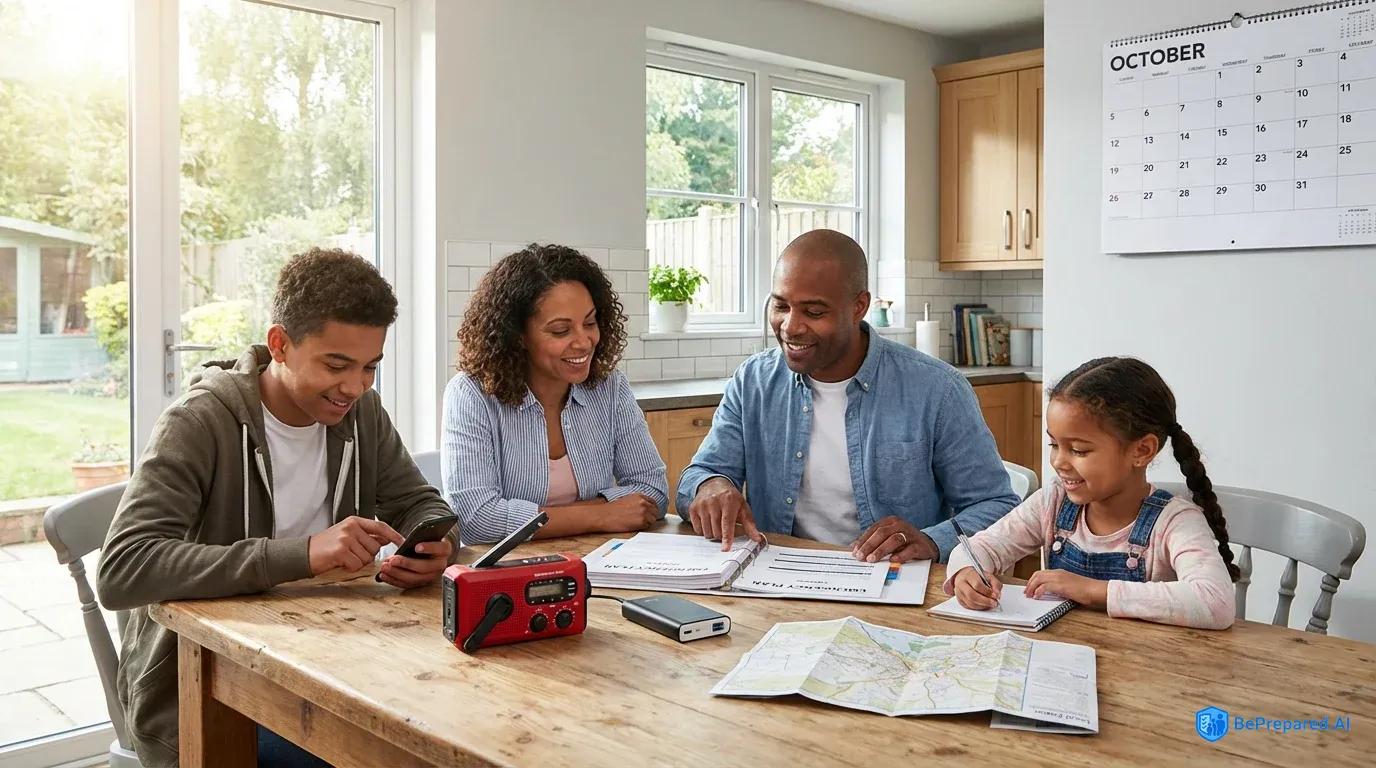
Why You Need a Communication Plan Before Civil Unrest
Sarah was at work downtown when the protests started three blocks away. Her husband Jake had picked up their daughter from school early and was stuck in gridlocked traffic on the other side of the city. Their teenage son was at soccer practice across town. Sarah tried calling Jake—nothing. She tried texting—the message hung with that little spinning wheel. She called her son. Straight to voicemail. In that moment, with sirens wailing and crowds gathering, Sarah realized she had no idea where her family was or how to reach them.
This scenario happens more often than most people realize. According to emergency preparedness data, approximately 71% of American families lack a proper emergency communication plan . When civil unrest erupts, families scatter in different directions—work, school, errands, activities—and suddenly finding each other becomes the most urgent priority. The problem is that the very moment you need your phone most desperately is often when it becomes least reliable.
During emergencies, cell networks become overwhelmed as thousands of people simultaneously try to call loved ones, check news, and post on social media. Towers can only handle so much traffic before they essentially freeze up. Add in potential power outages, damaged infrastructure, or deliberate shutdowns, and you've got a communication nightmare. Having a plan before anything happens isn't just smart—it's essential.
Beyond just making contact, civil unrest requires quick decision-making. Should you shelter in place or evacuate? Should your kids stay at school or come home? Where should everyone meet if home isn't safe? These decisions can't wait for you to figure out how to communicate. You need predetermined answers that everyone in your family already knows. The middle of a crisis is the worst possible time to start planning, yet that's exactly when most people realize they should have prepared months earlier.
The good news? Creating a communication plan is simpler than you think. You don't need expensive equipment or technical knowledge. You just need a few quiet hours to make some decisions with your family and write them down. Let's break this down into manageable steps that won't overwhelm you.
- Communication Methods Panel
- Hierarchy of contact options from cell phones to offline methods, with battery-powered radio as backup
Creating Your Basic Communication Plan
Building a solid communication plan doesn't require technical expertise or expensive equipment. Start with the foundation: designating an out-of-area contact person. This might seem counterintuitive—why would someone far away be more helpful than local contacts? The answer lies in how communication networks fail. During localized emergencies, phone systems can become overloaded in the affected area while working fine elsewhere. Your sister in another state might have perfectly functioning phone service while your entire city's network is jammed.
Choose someone who lives outside your immediate area, preferably in a different state or region. This person becomes your family's communication hub. Instead of everyone frantically trying to call each other, each family member contacts this one person to check in and share their status and location. Your out-of-area contact then relays information between family members. Make sure this person knows they have this responsibility and keeps a list of everyone's contact information. Give them permission to make decisions or relay instructions if needed.
Talk to your chosen contact person directly. Walk them through what you're asking them to do. Make sure they're comfortable with the role and understand how important it is. Send them your family's contact information and keep them updated when phone numbers change. Check in with them a couple times a year just to maintain the connection.
Next, establish your meeting locations with specific detail. Don't just say "meet at home"—what if home is in the danger zone? You need three predetermined locations: one right outside your home for minor emergencies like a fire, one in your neighborhood but away from your house, and one outside your neighborhood entirely. Be specific. "The big oak tree at Miller Park near the playground" works. "Somewhere in the park" doesn't. During high-stress situations, vague plans fall apart. Your brain doesn't think clearly when you're scared, so remove any ambiguity now.
When choosing your neighborhood meeting spot, pick somewhere everyone knows well. The corner store where you buy milk. The library where your kids go after school. The community center with the distinctive red door. Make it a place with clear landmarks that's easy to find even if you're stressed or approaching from an unfamiliar direction.
For your out-of-neighborhood location, choose somewhere accessible by multiple routes. If one road is blocked, you want alternatives. Think about a friend's house in the next town, a relative's workplace, or a recognizable public building. Make sure everyone knows the address and at least two different ways to get there.
Create physical emergency contact cards for every family member to carry in their wallet, backpack, or purse. These wallet-sized cards should list all family members' names and phone numbers, your out-of-area contact's information, and your three meeting locations. Include any critical medical information too. Yes, this information is probably in everyone's phones, but phones die, get lost, or break. A laminated card in your wallet works whether the power grid is up or down.
Compile and share a complete list of important numbers beyond just family. Include your children's schools, your workplace, nearby relatives, trusted neighbors, and even your family doctor. Program these into everyone's phones and write them down. Store paper copies in multiple places—your car's glove box, your home office, your emergency kit. Having these numbers accessible from different locations means you're never completely cut off from important contacts.
Download our free family communication plan template to get started today—it includes fillable sections for all these critical details and wallet-sized cards you can print and laminate.
Communication Methods During Civil Unrest
When civil unrest begins, your smartphone might not work the way you expect. Understanding which communication methods work under different conditions can mean the difference between coordinating effectively and operating blind. Let's compare your options and when each one shines or fails.
Voice calls are everyone's first instinct, but they're often the most fragile communication method during emergencies. Voice calls require significant bandwidth and sustained network connection. When cell towers become overloaded, voice calls are typically the first service to fail. Picture the network as a highway—voice calls are like wide trucks taking up lots of space. When traffic gets heavy, these trucks create gridlock fast.
Text messages, by comparison, are motorcycles weaving through that same traffic. They require minimal bandwidth and can queue up, waiting for brief moments of network availability to slip through. Emergency management agencies consistently report that text messages often work when voice calls fail . Texts can sit in your outbox for minutes or even hours, then suddenly send when the network catches a breath. During the 2013 Boston Marathon bombing, text messages were the primary working communication method while voice networks were completely jammed.
This is why your communication plan should prioritize texting over calling. Establish with your family that during emergencies, everyone texts first. Only call if you receive no text response after 30 minutes. This single habit change can dramatically improve your family's ability to stay connected when networks are stressed.
Keep your text messages short and clear. "Safe at work. Staying put." tells your family what they need to know without wasting bandwidth. Long, detailed messages take more time to send and receive. Save the full story for later when you're reunited.
Beyond cellular networks, consider two-way radios as a backup communication tool. Quality FRS (Family Radio Service) or GMRS (General Mobile Radio Service) radios can work without any infrastructure at all . They communicate directly between devices, which means they function even when cell towers are down, power is out, or networks are deliberately shut down. The range varies depending on terrain and obstacles, but they can provide reliable short-range communication when other methods fail.
If you decide to invest in two-way radios, get ones that are simple to operate. Your family members need to be able to use them under stress without fumbling through complicated menus. Look for radios with clear channel markings and simple on-off switches. Make sure everyone knows which channel your family will use and how to adjust the volume.
Social media and messaging apps offer another layer of redundancy. Apps like WhatsApp, Signal, or Facebook Messenger sometimes work when traditional SMS doesn't because they use data networks differently. However, these still require some level of internet connectivity. During widespread network failures, they'll fail just like voice calls. Think of them as a middle option—more reliable than voice calls but less reliable than basic SMS texts.
Email might seem old-fashioned, but it has one significant advantage: it's asynchronous and works across different networks. Someone can send an email from a working WiFi connection, and you might receive it hours later when you find your own internet access. It's not ideal for urgent communication, but it's another tool in your kit.
The key principle is redundancy. Don't rely on any single communication method. Your plan should include multiple options: text messages as primary, two-way radios as backup if you have them, an out-of-area contact as a relay, and predetermined meeting locations as the final fallback when all technology fails.
Remember that communication is just one piece of your overall preparedness. While you're thinking about staying connected with family, make sure you also have emergency supplies ready to last for at least two weeks . Water, food, medications, and basic supplies matter just as much as being able to reach each other.
Practice Your Plan: Monthly Communication Drills
Having a plan written down and having a plan that actually works are two completely different things. When stress hits, people default to habits, not plans they've read once and forgotten. Monthly drills transform your communication plan from a document in a drawer to automatic family behavior. Practice makes your plan feel natural instead of awkward or confusing.
Start with simple monthly check-ins that test your primary systems:
First Sunday of each month: Everyone texts the out-of-area contact at 2 PM, regardless of where they are. Your contact confirms receipt and practices relaying information between family members. This takes five minutes but builds the habit. Set a recurring reminder on everyone's phone so nobody forgets.
Quarterly full tests: Once every three months, simulate a real scenario. On a Saturday, everyone goes to different locations around town. At a predetermined time, implement your full communication plan—try calling (it should work, but practice anyway), send texts, and if you have radios, test those too. See how long it takes everyone to check in.
Annual meeting point practice: Once a year, actually go to each of your three designated meeting locations as a family. Walk the route from different starting points. Time how long it takes. Notice what landmarks help you find the exact spot. Your kids will remember "the park where we had that weird practice drill" far better than an address you told them once.
Testing reveals gaps you'd never notice otherwise:
Your out-of-area contact might have changed phone numbers. Your designated meeting spot might have been demolished for new construction. Your teenager might have gotten a new phone and never programmed in the emergency numbers. Your two-way radios might have dead batteries. Each drill is an opportunity to catch these problems before they matter.
Make drills engaging rather than tedious. Turn them into games for younger children. Time how fast everyone can send their check-in text. Give small rewards for remembering all three meeting locations. The goal is building muscle memory and family culture around preparedness, not creating a chore everyone resents.
For older kids and teens, explain why you're doing this. They're more likely to take it seriously if they understand the reasoning. Share real stories of families who struggled during emergencies because they had no plan. Let them help design parts of the plan so they feel ownership over it.
Track what works and what doesn't. Keep a simple log of your drills. Did texts go through immediately or take ten minutes? Could you reach your out-of-area contact on the first try? Did everyone remember the meeting locations? This data helps you refine your plan and shows you which communication methods are most reliable in your specific area.
Update your plan whenever circumstances change. Someone moves to a new school or job? Update the contact cards. Your favorite meeting spot closes down? Choose a new one and practice going there. Your out-of-area contact relocates closer to you? Pick someone new who lives farther away. A living plan that evolves with your family is infinitely more valuable than a perfect plan that sits unchanged in a drawer.
The families who navigate emergencies most successfully aren't necessarily the ones with the most elaborate plans—they're the ones who've practiced their basic plan until it becomes second nature. When Sarah from our opening scenario finally connected with her family three hours later, they had nowhere to meet and no backup plan. Don't let that be your family. Practice now, while it's easy and safe, so communication becomes automatic when everything else is chaos.
Taking Your First Step Today
You don't need to implement everything at once. Start with one simple action today: choose your out-of-area contact and call them. Have that conversation. Get their buy-in. That's it. You've started.
Next week, sit down with your family and pick your three meeting locations. The week after that, create your contact cards. Break this down into small, manageable pieces. Preparedness isn't about doing everything perfectly right now. It's about making steady progress toward being ready.
The plan you actually create and practice will always beat the perfect plan you never get around to making. Start simple. Start today. Your future self—the one dealing with an actual emergency—will thank you for taking these steps now.