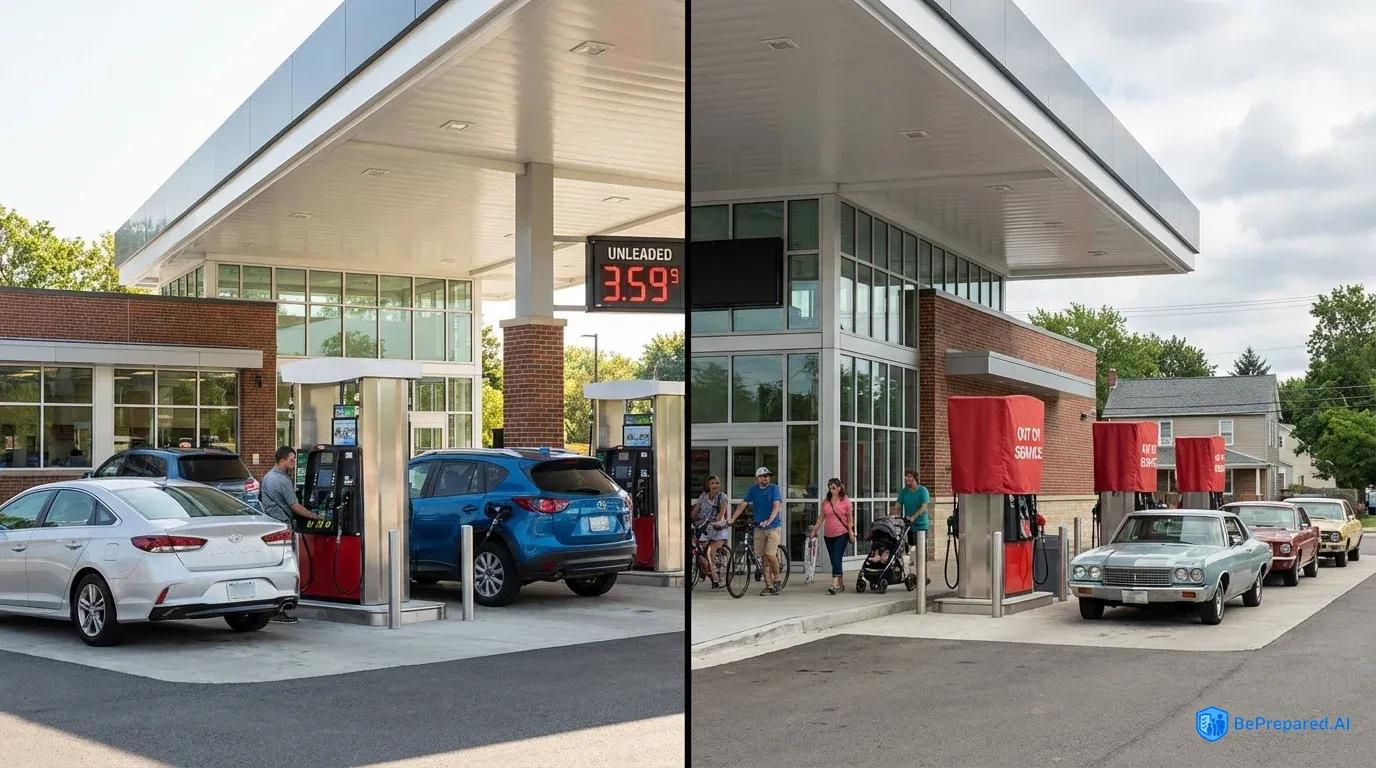
Understanding the Reality of Fuel Scarcity
Picture this: you're running late for work, and you glance at your dashboard to see the fuel gauge hovering near empty. No big deal—you'll just stop at the gas station on the corner, right? But when you pull in, yellow bags cover every pump handle, and a handwritten sign reads "Out of Gas." Your stomach drops as you realize the next three stations show the same scene.
This scenario isn't just hypothetical. Fuel shortages strike with surprising regularity, catching unprepared communities off guard. Natural disasters like hurricanes frequently disrupt refinery operations and distribution networks. We saw this during Hurricane Katrina and more recently with Hurricane Ida. Supply chain disruptions can create sudden scarcity, whether from cyberattacks on pipeline infrastructure or port congestion. Geopolitical events—trade disputes, conflicts in oil-producing regions, or sudden policy changes—can trigger shortages that ripple across entire nations .
The warning signs often appear before pumps run dry. News reports might mention refinery shutdowns or pipeline maintenance. You might notice prices creeping upward more rapidly than usual. Longer-than-normal lines at certain stations signal trouble ahead. Social media chatter about fuel availability in neighboring areas serves as an early alert system if you're paying attention.
Communities with diverse transportation options demonstrate 60% better resilience during fuel shortages compared to car-dependent areas . This statistic reveals an important truth: flexibility equals survival during disruptions. The families who weather these crises most successfully aren't necessarily those with the biggest fuel reserves. They're the ones who've built multiple backup plans before the shortage hits.
Understanding that fuel scarcity is a matter of "when" rather than "if" transforms how you approach your daily transportation habits. The good news? You don't need to overhaul your entire life overnight. Small changes now create big advantages later. Think of it like learning to swim—you start in the shallow end, practice basic skills, and gradually build confidence. Fuel shortage preparation works the same way.
- Combine Trips
- Plan multiple errands in one outing to minimize total driving distance
- Check Tire Pressure
- Maintain proper tire inflation monthly for optimal fuel efficiency
- Regular Maintenance
- Keep engine tuned and filters clean for best fuel economy
Immediate Steps to Reduce Fuel Dependency
The simplest preparedness strategy costs nothing and starts right now: keep your car's gas tank at least half full at all times . This "half-tank rule" isn't just cautious advice—it's practical mathematics. A half-full tank in most vehicles gives you crucial time to adapt when shortages strike. That buffer means you're not competing in the initial panic rush when stations still have fuel but lines stretch for blocks.
Start implementing this rule today, even when gas flows freely. The habit needs to become automatic, so when stress hits, you're already protected. Think of it like keeping extra batteries in your drawer—you don't wait until the power goes out to buy them. Each time your gauge approaches the halfway point, treat it as a refueling trigger. Yes, you'll visit gas stations more frequently, but you'll never face that heart-pounding moment of searching for an open pump while running on fumes.
Strategic errand combination can cut your consumption by up to 50% . Instead of making three separate trips for groceries, the pharmacy, and the bank, map out a single efficient route hitting all locations. This approach requires planning—keep a running list on your phone of errands, and batch them into one or two weekly trips rather than daily outings.
The planning process becomes easier with practice. Sunday evening, review your week ahead. Which appointments are non-negotiable? What errands can shift by a day or two? Plot locations on a map app and look for clustering opportunities. Maybe Tuesday's dentist appointment sits near the grocery store and post office—suddenly three trips become one circular route.
Cold starts—when you drive somewhere, park, let the engine cool, then restart—waste significant fuel. Each eliminated cold start improves your efficiency. Your wallet benefits during normal times, and your fuel tank stretches further during shortages.
Carpooling arrangements need establishment before crisis strikes. Start conversations now with coworkers, neighbors, or parents at your kids' school. During normal times, carpooling saves money and reduces wear on your vehicle. During shortages, it becomes essential infrastructure. A group of four coworkers sharing rides cuts individual fuel needs by 75%. Establish the framework now—who drives which days, pickup schedules, fuel cost sharing—so when shortages hit, you simply activate an existing plan rather than scrambling to organize strangers under pressure.
Don't let this overwhelm you. Pick just one action this week. Maybe you commit to the half-tank rule. Maybe you combine two errands you normally do separately. Small wins build momentum and confidence.
Alternative Transportation Options
When fuel becomes scarce or prohibitively expensive, your backup transportation methods determine whether you maintain normalcy or face isolation. The humble bicycle represents perhaps the most practical alternative, but there's a vast difference between owning a bike and having a truly functional bicycle transportation system ready to deploy.
Standard bicycles offer reliable, fuel-free transportation for shorter trips around your neighborhood and town. They work well for distances you'd normally drive in just a few minutes. Electric bikes extend that practical range significantly, making longer commutes feasible even for riders without serious athletic conditioning . The comparison reveals why e-bikes have exploded in popularity—they eliminate the "arriving sweaty" problem that makes traditional cycling impractical for many work commutes.
During fuel shortages, an e-bike with a charged battery provides transportation independence that feels almost luxurious compared to waiting in gas lines. You zip past stalled traffic, arrive fresh, and never worry about pump prices.
The catch? Your bicycle needs to actually work when you need it. That dusty bike in your garage with flat tires, rusty chains, and seized brakes won't save you during an emergency. Maintenance matters. Learn basic bike upkeep now: how to inflate tires to proper pressure, lubricate chains, adjust brakes, and fix a flat tire.
Consider investing in panniers or a rear rack for carrying groceries and supplies. A backpack works briefly, but creates shoulder strain on longer rides. Equip your bike with lights and reflectors for visibility. Map out safe routes to your frequent destinations. Roads designed for cars often have safer parallel routes through neighborhoods that experienced cyclists already know.
Walking often gets dismissed as too slow or limited, but many households sit within walking distance of at least some essential services. A typical walking pace covers ground faster than you might think. The comparison shifts dramatically when you factor in gas lines during shortages. Would you rather walk to the nearby pharmacy, or drive but wait 90 minutes in line for fuel?
Public transit familiarity deserves attention even if you've never ridden a bus in your city. Download your local transit app now and explore route options to your workplace, grocery stores, medical facilities, and schools. Take a practice trip on a relaxed Saturday to understand how the system works. Learn where to buy passes, how to read schedules, and which stops serve which routes.
During fuel shortages, public transit often continues operating because buses and trains receive priority fuel allocation. The people who've never used the system struggle with confusion and delays. Those familiar with routes navigate efficiently and get where they need to go.
Start your fuel shortage preparation today by checking your current gas tank level and mapping out alternative routes to essential locations. Identify which destinations you could reach by bike or foot, and which would require public transit. This knowledge transforms from theoretical to practical when you actually need it.
Here's your simple action step: this weekend, take one trip you'd normally drive and use an alternative method instead. Walk to the corner store. Bike to a friend's house. Ride the bus to the library. You'll discover these options aren't as difficult as you imagined, and you'll build real-world experience that pays off during emergencies.
Emergency Fuel Storage and Safety
Storing emergency fuel supplies requires strict adherence to safety protocols. Improper storage creates fire hazards that can destroy your home and endanger lives. The foundation of safe fuel storage starts with approved containers specifically designed and certified for gasoline or diesel. These aren't just recommendations—they're critical safety requirements that prevent catastrophic failures.
Store emergency fuel only in approved containers away from living spaces . Approved fuel containers feature specific design elements: flame arrestors that prevent external ignition sources from igniting vapors inside, pressure relief mechanisms that prevent rupture from temperature changes, and spill-proof spouts that minimize exposure during pouring.
Never use milk jugs, water bottles, or other improvised containers. These materials degrade when exposed to fuel, creating leak risks and releasing dangerous vapors. The few dollars saved aren't worth the fire risk or toxic exposure. Look for containers marked with UL or FM approval stamps, typically available at auto parts stores or home improvement centers .
Storage location matters as much as container selection. Fuel must stay away from living spaces—never store gasoline in your house, attached garage, or basement. The ideal location is a detached shed or outdoor storage cabinet with ventilation, positioned away from ignition sources like water heaters, electrical panels, or power tools.
Temperature stability helps too. Extreme heat accelerates fuel degradation while extreme cold can affect some container materials. Concrete floors provide better spill containment than dirt or wood surfaces.
Gasoline doesn't last forever. Fuel stabilizer products help extend storage life, but even treated fuel requires rotation to ensure reliability. Add stabilizer immediately when filling storage containers, following manufacturer instructions carefully. Label each container with the storage date using permanent marker, creating a clear rotation schedule.
Rotation prevents waste and ensures your emergency supply actually works when needed. Every few months, pour your stored fuel into your vehicle's tank and refill the storage containers with fresh fuel and stabilizer. This cycle maintains a constant emergency reserve while preventing degradation. Some preparedness-minded individuals time their rotation with seasonal changes—spring, summer, fall, winter—creating an easy-to-remember schedule.
The rotation process also provides regular practice with safe fuel handling procedures. These skills stay sharp rather than remaining theoretical knowledge you've never actually applied.
Quantity decisions depend on your specific needs and local regulations. Check your city or county rules about residential fuel storage limits before buying containers. Calculate your vehicle's fuel consumption for essential trips only—not your normal driving, but the absolute minimum needed for critical errands during a shortage.
Many households find that a modest emergency reserve provides adequate buffer against short-term disruptions without creating excessive risk or regulatory issues. This supply, combined with maintaining your vehicle's tank above half-full, creates substantial protection while keeping storage risks manageable.
Remember, fuel storage isn't mandatory for everyone. If you live in an apartment or lack safe storage space, focus instead on the half-tank rule and alternative transportation options. You can prepare effectively without storing a single gallon of fuel. The goal is building resilience through multiple strategies, not checking every box on someone else's list.
Start simple. If fuel storage makes sense for your situation, begin with one approved container and practice the complete cycle: purchase, stabilize, store safely, rotate. Master the basics before expanding your reserves. Confidence comes from competence, and competence comes from starting small and building gradually.