Why Nuclear Emergency Communication Plans Matter
The morning of March 11, 2011, started like any other for thousands of families living near Japan's Fukushima Daiichi Nuclear Power Plant. Parents dropped children at school, workers commuted to their jobs, and life followed its predictable rhythm. Then, at 2:46 PM, a massive earthquake struck, followed by a devastating tsunami. Within hours, the nuclear plant's cooling systems failed, triggering a catastrophic meltdown. But for many families, the nuclear emergency itself wasn't their only crisis—they couldn't communicate with each other. Cell towers toppled, power grids collapsed, and conventional communication networks went dark . Parents had no way to reach their children. Spouses couldn't confirm each other's safety. The communication blackout transformed an already terrifying situation into a nightmare of uncertainty.
This scenario illustrates a harsh reality that most families never consider: when you need communication systems most desperately, they're likely to fail. During nuclear emergencies, whether from reactor accidents, dirty bombs, or nuclear detonations, the infrastructure we depend on daily becomes unreliable or completely unavailable . Power outages disable cell towers. Network congestion from thousands of simultaneous calls creates digital gridlock. Physical damage to communication infrastructure can leave entire regions disconnected. Yet this is precisely when family members need to locate each other, confirm safety, and coordinate protective actions.
The mathematics of separation during emergencies are sobering. Consider a typical family of four: two working parents, one child in school, another in daycare. On any given weekday, they're scattered across different locations, potentially miles apart. When a nuclear emergency strikes without warning, each family member faces different immediate threats and must make rapid decisions about shelter, evacuation routes, and protective actions. Without a pre-established communication plan, each person operates in isolation, making independent decisions based on incomplete information. The probability of the family successfully reuniting drops dramatically with each hour of communication failure.
This is why nuclear emergency communication planning isn't optional—it's a survival imperative. Standard communication networks that work flawlessly during normal conditions buckle under emergency stress. Research confirms what Fukushima demonstrated: text messages are significantly more likely to penetrate congested networks than voice calls because they require less bandwidth . But even this knowledge helps only if your family has predetermined who will text whom, what information to include, and what actions different messages trigger. Studies show that redundant communication systems increased survival rates by 47% in nuclear emergency scenarios . Multiple backup methods don't just increase your chances of success—they multiply them exponentially, creating redundancy that can mean the difference between family reunion and prolonged separation.
- Meeting Location Details
- Primary and secondary meeting points with address fields and map integration examples
- Document Checklist
- Interactive checklist with green verification marks for critical family documents and records
Creating Your Family Communication Plan
Building an effective family communication plan starts with accepting an uncomfortable truth: you won't all be together when disaster strikes. Most nuclear emergencies, whether accidental or intentional, occur without warning during normal business hours when families are maximally dispersed. Your plan must account for this reality by creating a framework that works regardless of where each person happens to be when the emergency begins.
Step One: Designate Your Out-of-Area Contact Person
The first and most critical step involves selecting someone who lives well outside your area to serve as your family's central communication hub. This might seem counterintuitive—why would someone farther away be more helpful than local contacts? The answer lies in how disasters affect communication networks. During localized emergencies, including nuclear incidents at specific facilities, regional cell towers become overwhelmed by local call volume or may suffer physical damage . However, long-distance calls routing through unaffected infrastructure often connect successfully when local calls fail.
Your out-of-area contact becomes the family switchboard: each member contacts this person to report their status and location, and the contact person relays information between family members who can't reach each other directly. Choose someone who lives far enough away that they won't be affected by the same regional infrastructure failures you're experiencing. Many emergency planners recommend selecting someone in a different state or at minimum in a different metropolitan area.
Choose this person carefully. They need to be reliable, likely to be available during business hours, and willing to accept this responsibility. Ideal candidates include retired parents, siblings in different states, or close friends in distant cities. Once selected, provide them with comprehensive information about each family member: full names, physical descriptions, medical conditions, workplace addresses, school locations, and typical daily schedules. This contact person should also understand your family's predetermined meeting locations and evacuation routes, which we'll discuss next.
Step Two: Establish Primary and Secondary Meeting Locations
Your plan needs three distinct meeting locations, each serving different scenarios. The first is a neighborhood location—somewhere within walking distance of your home where family members can gather if home isn't accessible but the immediate area is safe. This might be a specific street corner, a neighborhood park, or a recognizable landmark. The second location should be outside your immediate neighborhood but still within your community, useful if your neighborhood must be evacuated but the broader area remains safe. Consider locations like a specific public library branch, a friend's house across town, or a community center you all know.
The third location should be outside your city or region entirely, designated for scenarios requiring large-scale evacuation. This might be a relative's home in another state or a specific hotel in a predetermined distant city. This location accounts for worst-case scenarios where contamination zones or mandatory evacuation perimeters force you to leave the entire area.
Document these locations with extreme specificity. "The park near our house" becomes ambiguous under stress; "The northwest corner of Riverside Park at the intersection of Oak Street and River Road" leaves no room for confusion. Include physical addresses, GPS coordinates, and distinctive landmarks. Remember that during nuclear emergencies, certain areas may become inaccessible due to contamination zones or mandatory evacuation perimeters established by authorities . Your multiple meeting locations create flexibility to adapt to various scenarios.
Step Three: Document Everything in Physical Form
Digital convenience has made us dangerously dependent on devices that may not function during emergencies. Your smartphone's contact list becomes useless when the battery dies and power grids are down. Cloud storage doesn't help when internet connectivity disappears. This is why physical documentation remains essential—paper works without electricity, doesn't require passwords, and can't be remotely wiped by security protocols .
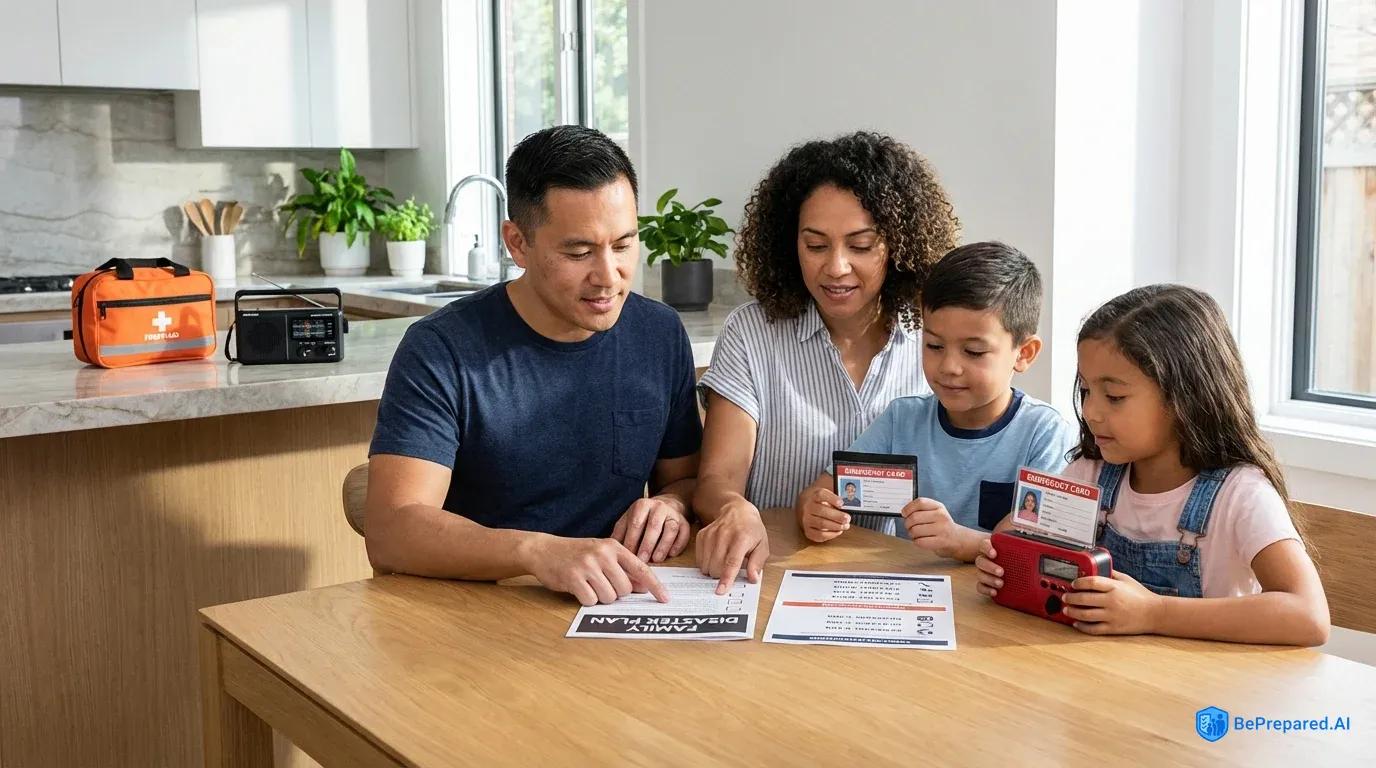
Create a wallet-sized card for each family member containing all essential information: names and phone numbers for all family members, the out-of-area contact person's information, all three meeting locations with addresses, and any critical medical information. Laminate these cards to protect them from water damage. Each family member should carry this card at all times—in wallets, purses, or backpacks. For young children, consider attaching the card to their backpack's interior or keeping it in a sealed pocket.
Create a comprehensive family communication plan document that includes more detailed information: extended family contacts, workplace addresses with main phone numbers, school contact information, medical provider details, and any special considerations like medication requirements or mobility limitations. Place copies of this document in multiple locations: your home emergency kit, your vehicle, your workplace, and with your out-of-area contact person. This redundancy ensures that even if you can't access one copy, alternatives exist.
Step Four: Ensure Everyone Understands the Plan
Documentation alone accomplishes nothing if family members don't understand how to use it. Schedule a family meeting specifically to review the communication plan. Walk through different scenarios: "If a nuclear emergency happens while Dad is at work, Mom is at the grocery store, and you two are at school, what do you do?" Have children practice reciting the out-of-area contact's phone number. Discuss what information to communicate: location, physical condition, immediate plans, and which meeting location you're heading toward.
For younger children, simplify the plan to its core elements. They need to know: who to call, what to say, and where to go. Practice these steps until they become automatic. Older children and teenagers can understand more complex scenarios and should participate in planning discussions. Their input often reveals practical problems adults might overlook—like the fact that their school locks phones in lockers during the day, requiring alternative communication strategies.
[MEDIUM CTA: Download Our Family Communication Plan Template]
Backup Communication Methods
When conventional communication networks fail, alternative methods become lifelines. Understanding the technical capabilities and limitations of various backup systems allows you to build redundancy into your communication strategy, ensuring that if one method fails, others remain available. Each backup method operates on different infrastructure or principles, creating true independence that prevents single points of failure.
Text Messaging: Your First Backup
Text messaging deserves recognition as a primary backup communication method because of its technical efficiency during network congestion. Text messages are significantly more likely to penetrate congested networks than voice calls because they require less bandwidth . During emergencies when thousands of people simultaneously attempt communication, this difference becomes critical. Text messages can queue in network buffers and transmit during brief moments of available bandwidth, while voice calls simply fail to connect. During the 2011 Japanese earthquake and tsunami, text messages successfully transmitted when voice networks were completely saturated.
However, text messaging shares infrastructure vulnerabilities with voice networks. Both depend on functioning cell towers, electrical power, and network switching systems. When these systems fail—whether from physical damage, electromagnetic pulse effects, or prolonged power outages—text messaging fails too. This is why additional backup methods operating on entirely different principles become necessary.
Pros of Text Messaging:
- Works on existing devices everyone already carries
- No additional equipment purchase required
- More reliable than voice calls during network congestion
- Can queue for delivery when networks are temporarily unavailable
- Requires minimal training or technical knowledge
Cons of Text Messaging:
- Depends on the same vulnerable infrastructure as voice calls
- Fails completely when cell towers lose power or sustain damage
- Network congestion can still delay messages for hours
- Requires charged phone batteries
- May not work in areas with poor cellular coverage
Two-Way Radios: Independent Short-Range Communication
Family Radio Service (FRS) and General Mobile Radio Service (GMRS) radios provide communication capability that's completely independent of cellular networks and electrical grids. These handheld devices communicate directly with each other using radio frequencies allocated by the Federal Communications Commission specifically for personal use. FRS radios require no license and can provide useful range in most emergency scenarios. GMRS radios, which require an inexpensive FCC license, provide significantly more power and extended range with proper equipment .
The critical advantage of two-way radios is their complete independence from infrastructure. When cell towers are down, power grids have failed, and internet connectivity is nonexistent, two-way radios continue functioning as long as their batteries hold charge. This makes them invaluable for family members attempting to coordinate within the same general area—for example, when searching for each other in an evacuation scenario or when some family members have reached shelter while others are still in transit.
The limitations are equally important to understand. Range restrictions mean two-way radios work only when family members are relatively close together. Buildings, terrain, and urban density can significantly reduce effective range. During major emergencies, the limited number of FRS/GMRS channels can become congested with other users, though this is less problematic than cellular network congestion because the communication range is inherently limited. For two-way radios to be effective, all family members must carry them, keep them charged, and know which channel the family has predetermined for emergency use.
Pros of Two-Way Radios:
- Complete independence from cellular and power infrastructure
- No monthly service fees after initial purchase
- Instant communication without dialing or waiting for connection
- Works in areas with no cellular coverage
- Relatively affordable for basic models
- Simple operation that children can learn quickly
Cons of Two-Way Radios:
- Limited range, especially in urban environments or rough terrain
- Requires all family members to carry additional devices
- Battery life becomes critical during extended emergencies
- Privacy concerns as others can monitor your channel
- May not work if family members are separated by significant distances
- Requires coordination on which channel to use
Ham Radio: Long-Distance Communication Capability
Amateur radio (ham radio) represents a more sophisticated backup communication option with capabilities that far exceed other methods. Licensed amateur radio operators can communicate across continents using high-frequency radio waves that bounce off the Earth's ionosphere, enabling communication when all conventional infrastructure has failed. Ham radio operators provided critical communication links during Chernobyl, Fukushima, and Three Mile Island incidents . These operators relayed emergency information, coordinated rescue efforts, and helped separated families locate each other when other systems failed.
The power of ham radio comes with complexity. Operating amateur radio requires passing an FCC licensing exam that tests knowledge of radio theory, regulations, and operating procedures. The equipment can be more expensive and sophisticated than simple two-way radios, and effective operation requires practice and skill development. However, for families serious about emergency preparedness, having at least one licensed amateur radio operator provides communication capabilities that can function when literally everything else has failed.
You don't need every family member to become a ham radio operator. One licensed family member with appropriate equipment can establish communication with emergency networks, receive official information from authorities, and potentially relay messages to distant family members through the amateur radio community's emergency networks. Many communities have amateur radio emergency service (ARES) groups that activate during disasters specifically to provide communication support.
Pros of Ham Radio:
- Can communicate over extremely long distances without infrastructure
- Access to emergency communication networks and information
- Multiple frequency bands provide flexibility
- Community of operators willing to relay emergency messages
- Can receive official emergency broadcasts
- Equipment can be powered by batteries or generators
Cons of Ham Radio:
- Requires FCC license and passing technical exam
- Equipment costs can be substantial
- Significant learning curve for effective operation
- Requires regular practice to maintain skills
- Antennas may be damaged during disasters
- Not all family members will have the knowledge to operate equipment
Satellite Communication: Ultimate Backup
Satellite phones and satellite messengers represent the most reliable—and most expensive—backup communication option. These devices communicate directly with satellites orbiting Earth, completely bypassing terrestrial infrastructure . When cell towers are destroyed, power grids are down, and regional infrastructure has collapsed, satellite communication devices continue functioning normally. This reliability comes at a cost: satellite communication devices and their service plans represent a significant investment.
For most families, satellite phones may seem excessive for nuclear emergency preparedness. However, satellite messenger devices like the Garmin inReach or SPOT offer a more affordable middle ground. These devices provide two-way text messaging via satellite. While they don't offer voice calling, they enable communication from anywhere on Earth, regardless of infrastructure status. The messages are brief—similar to SMS—but sufficient for critical communication: "I'm safe, heading to meeting location B" or "Sheltering at workplace, unable to move yet."
The decision to invest in satellite communication depends on your family's specific situation, budget, and risk assessment. Families living near nuclear facilities, in areas with vulnerable infrastructure, or with members who regularly travel might find the investment worthwhile. The key is understanding that satellite communication represents the ultimate backup—the method that works when absolutely everything else has failed.
Pros of Satellite Communication:
- Functions anywhere on Earth with clear view of sky
- Complete independence from terrestrial infrastructure
- Most reliable option during catastrophic infrastructure failure
- Can send location coordinates automatically
- Some devices include SOS emergency features
- Works in remote areas with no other communication options
Cons of Satellite Communication:
- High initial equipment costs
- Ongoing monthly service fees even when not in use
- Requires clear view of sky to function
- Message transmission can be slower than cellular
- Limited or no voice calling on messenger devices
- Devices require charging and battery maintenance
Testing and Maintaining Your Plan
Creating a comprehensive family communication plan represents significant effort, but the plan becomes worthless if it's never tested, equipment isn't maintained, and information becomes outdated. Regular testing transforms theoretical plans into practiced responses that family members can execute automatically during actual emergencies when stress and fear compromise decision-making ability.
Establish a Regular Testing Schedule
Monthly communication drills: Once per month, conduct a surprise communication drill. Send a text message to all family members during normal business hours: "This is a drill. Contact out-of-area person within 30 minutes and report your location." This simple exercise accomplishes multiple goals simultaneously. It verifies that everyone still has current contact information accessible, confirms that the out-of-area contact person's number hasn't changed, ensures family members remember the procedure, and reveals any problems with the plan while you still have time to fix them. Research on emergency preparedness consistently shows that monthly drills significantly improve response time and success rates during actual emergencies .
Quarterly equipment testing: Emergency notification systems must be tested quarterly . Every three months, test all backup communication devices. Turn on two-way radios and verify they communicate with each other. Check that batteries hold charges or replace them if they don't. Test ham radio equipment if you have it, making actual contacts to ensure everything functions properly. Verify that satellite communication devices power on and can send test messages. Battery-powered devices deteriorate when stored unused; batteries self-discharge, contacts corrode, and electronic components degrade. Regular testing catches these problems before emergencies make them critical.
Semi-annual full-scale drills: Twice yearly, conduct a comprehensive drill that simulates actual emergency conditions. On a predetermined date, all family members should be at their normal locations—work, school, home, or wherever they'd typically be on a weekday. At an unannounced time, activate the drill: everyone must contact the out-of-area person, report their status and location, and then attempt to reach the designated meeting location. This reveals realistic problems: How long does it actually take to get from work to the meeting location during normal traffic? Can children successfully execute the plan without adult guidance? Do the meeting locations actually work as intended?
Annual plan review and update: Once per year, gather the family for a complete plan review. Update all contact information, as phone numbers and addresses change. Verify that meeting locations are still appropriate—construction might have eliminated a landmark, or a business you planned to use as a meeting point might have closed. Review and update medical information, especially for children whose conditions and medications may change as they grow. Replace laminated wallet cards with updated versions. Confirm that your out-of-area contact person is still willing and able to serve in that role.
Equipment Maintenance Requirements
Battery rotation and replacement: Batteries are the Achilles heel of emergency communication equipment. Establish a battery maintenance schedule: test alkaline batteries every three months and replace them every six months regardless of testing results, as they self-discharge over time. For rechargeable batteries in two-way radios or satellite devices, perform a complete charge-discharge cycle quarterly to maintain capacity. Keep replacement batteries stored properly—in cool, dry locations, in original packaging when possible.
Device firmware updates: Many modern communication devices, including satellite messengers and some advanced two-way radios, receive firmware updates that improve functionality and fix bugs. Check manufacturer websites semi-annually for updates and install them. This ensures your equipment functions optimally when needed.
Physical inspection and cleaning: Annually inspect all communication devices for corrosion, damage, or wear. Clean battery contacts with appropriate contact cleaner. Verify that waterproof seals on devices remain intact. Check that antennas are securely attached and undamaged. Replace any equipment showing significant deterioration.
Documentation Updates
Contact information verification: Phone numbers change, people move, and email addresses become obsolete. Annually verify every piece of contact information in your plan: call each number to confirm it's still correct, verify addresses haven't changed, and update email addresses. This seems tedious but becomes critical during emergencies.
Workplace and school updates: Children change schools, parents change jobs, and these changes invalidate portions of your plan. Whenever these changes occur, immediately update all documentation and redistribute updated wallet cards to family members.
Medical information currency: Medication lists, allergy information, and medical conditions require regular updates, especially for children or family members with evolving health conditions. Review and update medical information during your annual plan review.
Making Your Plan Work When It Matters
The difference between a communication plan that works and one that fails often comes down to maintenance and testing. Plans created with great care but never tested become fantasy documents that provide false confidence. Equipment purchased but never maintained fails at critical moments. Information documented but never updated becomes misleading rather than helpful.
The families who successfully reunite during nuclear emergencies aren't necessarily those with the most sophisticated plans—they're the ones who've practiced their plans enough times that execution becomes automatic, even under the extreme stress of actual disaster conditions. When a real emergency strikes, you won't have time to figure things out. You'll fall back on what you've practiced.
Start with the basics: designate your out-of-area contact, establish your meeting locations, and create your documentation. Then build from there based on your family's specific needs and resources. A simple plan that everyone understands and has practiced beats a complex plan that exists only on paper.
Test your plan monthly. Update it annually. Maintain your equipment quarterly. These aren't suggestions—they're requirements for a plan that will actually work when your family needs it most. The time you invest now in preparation and practice could mean the difference between confusion and coordination, between separation and reunion, during the most critical hours of a nuclear emergency.
Your family's safety during a nuclear emergency depends on communication. Don't leave it to chance.