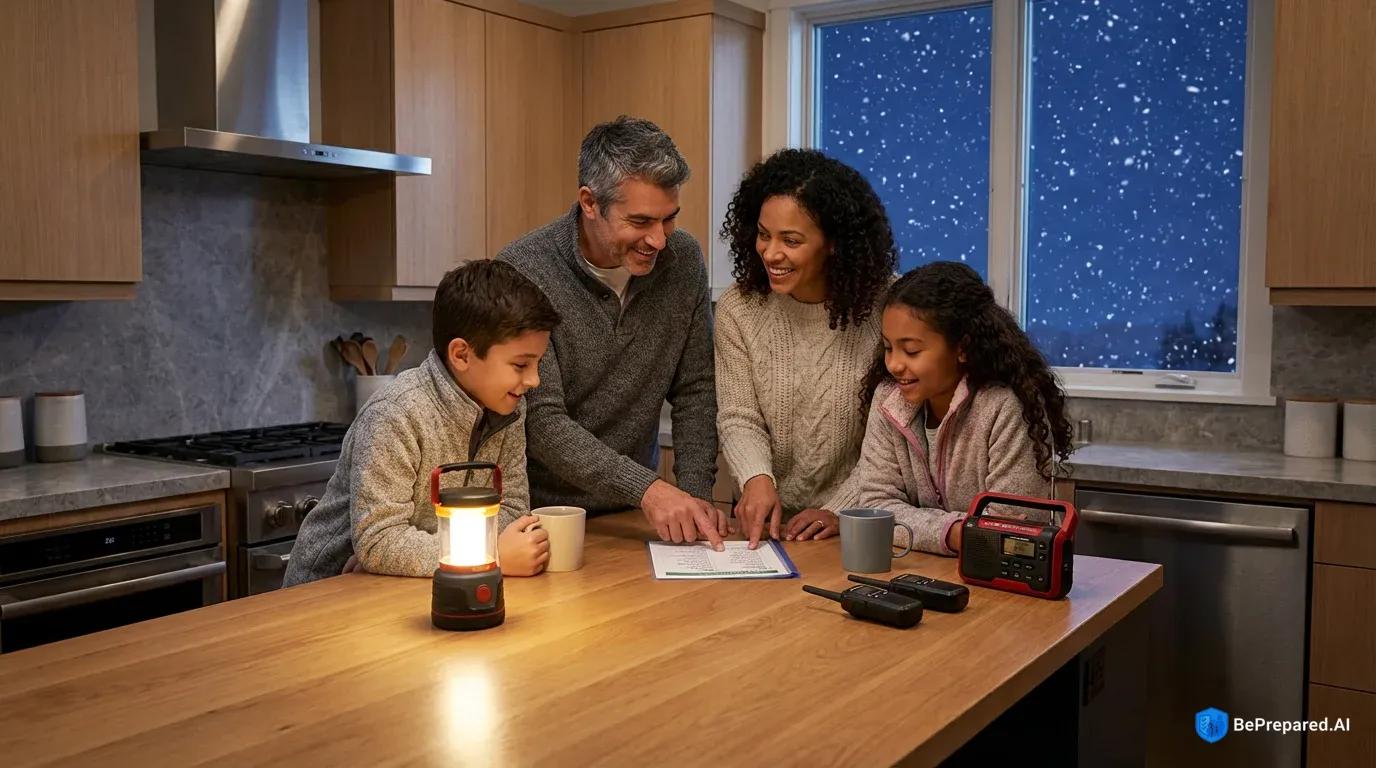
Why You Need a Winter Storm Communications Plan
Picture this: It's 2 a.m. on a February night when the power suddenly cuts out. Through your window, you can hear trees cracking under the weight of ice. Your teenager was supposed to be at a friend's house across town, but now your cell phone shows no signal. Your spouse is stranded at work. And you're sitting in the dark, wondering if everyone you love is safe.
This scenario plays out thousands of times every winter across America. When winter storms hit, they don't just bring snow and ice—they bring communication blackouts that can last for days. Cell towers lose power or become damaged by ice accumulation. Even when towers remain functional, the networks become overloaded as everyone tries to reach their loved ones at the same time.
Family separation during winter storms happens more often than most people realize. Someone runs to the grocery store for supplies and can't make it back home. A parent gets stuck at the office when roads become impassable. Kids are at school when conditions deteriorate rapidly. Without a solid communication plan in place before the storm hits, these normal separations transform into anxiety-filled emergencies.
The reality is that our everyday communication methods are surprisingly fragile. We've become so dependent on our smartphones that we rarely consider what happens when they stop working. During severe winter weather, cell networks often fail within the first few hours . The infrastructure we rely on every single day—those invisible cell towers and power lines—becomes compromised by ice, wind, and falling trees.
Here's the good news: creating a winter storm communications plan is simpler than you think. You don't need to become a survival expert or spend hundreds of dollars. Having a winter storm communications plan isn't about being paranoid—it's about being realistic. When regular methods fail, you need backup options already in place, not scrambling to figure things out in the dark. Let's break this down into manageable steps that anyone can follow.
- Battery-Powered Radio
- NOAA weather radio with AM/FM bands for emergency broadcasts and news
- Emergency Whistle
- Loud signal whistle for attracting attention when phones don't work
- Hand-Crank Flashlight
- No-battery light source with built-in emergency radio and phone charger
- Two-Way Radios
- Walkie-talkies with 2-mile minimum range for family communication
- Solar Charger
- Compact panel to charge devices when power grid is down
Essential Communication Devices
When winter storms knock out your primary communication methods, having the right backup devices can mean the difference between staying connected and being completely isolated. The key principle here is redundancy—multiple tools serving overlapping purposes, each with its own power source and method of operation. Don't worry about getting everything at once. Start with one device and build from there.
Battery-Powered and Hand-Crank Weather Radios
A NOAA Weather Radio should be your first investment in emergency communications. These specialized radios receive continuous weather broadcasts and emergency alerts directly from the National Weather Service . Look for models with multiple power options: battery backup, hand-crank generators, and solar panels.
The hand-crank feature is particularly valuable because it works when everything else fails. Store this radio in an accessible location where everyone in your family knows to find it. Keep a supply of fresh batteries specifically designated for this device, stored separately from your everyday battery drawer.
Many affordable models cost between $30 and $50 and include all the features you need. You don't need the fanciest option to stay safe.
Two-Way Radios and Their Advantages
Two-way radios, also called walkie-talkies or FRS (Family Radio Service) radios, work independently of any network infrastructure . This is their superpower during winter storms. While your cell phone needs towers and electricity to function, two-way radios communicate directly with each other.
Purchase radios that use rechargeable batteries, and keep both the radios and spare batteries fully charged during winter months. Consider getting enough radios so that each family member can carry one, plus extras for vehicles. Basic two-way radios start around $25 per pair, making them an affordable backup option.
These radios work best when family members are relatively close to each other. Buildings, hills, and trees will affect how far the signal travels, but they're perfect for staying in touch around your neighborhood or town.
Cell Phones with Smart Power Management
Your smartphone remains valuable even during emergencies, but only if it has power. Invest in multiple charging solutions: a car charger, a solar-powered charger, and at least one fully-charged portable battery bank. Here's a critical fact: text messages use significantly less bandwidth than phone calls and have a much higher delivery success rate during emergencies when networks are congested .
Even when you can't complete a voice call, text messages often get through. They can queue and send during brief moments of connectivity. This makes texting your most reliable cell phone option during a winter storm.
Keep your portable battery banks charged and ready. Check them monthly to make sure they haven't lost their charge sitting in a drawer.
Landline Telephones
If you still have a traditional landline (not VoIP or internet-based phone service), keep at least one corded phone that doesn't require electrical power. Landline infrastructure often remains functional when cell networks fail. Corded phones draw their power directly from the phone line itself.
This old-school technology has saved countless people during extended power outages. If you don't have a landline, don't rush out to get one—focus on the other tools first.
Store all communication devices together in a designated emergency kit location. Pick a spot that's easy to access in the dark, like a hall closet or kitchen cabinet. Label it clearly so everyone knows where to look.
Creating Your Family Communication Plan
Building an effective family communication plan requires more than just good intentions—it needs structure, documentation, and practice. The process might seem overwhelming at first, but we'll break it into simple steps. You can complete the basic plan in about an hour, then refine it over time.
Step 1: Designate Your Out-of-Area Contact Person
Choose a friend or family member who lives far away from you, ideally in a different state or region. This person becomes your family's communication hub. Here's why this works: during regional emergencies, local phone lines often become jammed with calls, but long-distance lines frequently remain open .
When family members can't reach each other directly, they can each call the out-of-area contact to check in and relay messages. Your contact person should maintain a list of all family members' phone numbers, addresses, and any special medical needs.
Call this person now, explain their role, and make sure they're willing to serve this function. Give them written information about each family member. Update this information once a year, perhaps on a specific date that's easy to remember like New Year's Day.
Step 2: Establish Primary and Secondary Meeting Points
Identify two physical locations where family members will reunite if separated during a winter storm. Your primary meeting point should be your home, but what if home isn't accessible? Your secondary meeting point might be a nearby relative's house, a community center, a church, or even a specific parking lot.
The key is specificity—don't just say "the library." Instead, specify "the main entrance of the Central Branch Library on Oak Street." Everyone in the family should be able to reach these locations from their regular daily routes.
Walk through the routes together if possible. Discuss what to do if roads are impassable. Talk about alternative routes and backup plans.
Step 3: Document Everything in Writing
Create physical copies of your communication plan—not just digital versions that require power to access. Each family member should carry a wallet-sized card with critical information: the out-of-area contact's phone number, meeting point addresses, and each family member's cell phone number.
Yes, you have these numbers in your phone, but what happens when your phone dies? Write them down. Create a full-sized version of the plan to post on your refrigerator.
Include a list of important phone numbers: local emergency services, utility companies, neighbors, and nearby relatives. Laminate these cards so they'll survive getting wet or worn.
Step 4: Share and Discuss the Plan with Everyone
Schedule a family meeting specifically to review your communication plan. Make it casual—maybe over dinner or during a weekend afternoon. Walk through different scenarios: "What if Mom is at work and the kids are at school when a storm hits?" or "What if we can't reach each other by phone?"
Make sure even young children understand the basics. They should know the out-of-area contact's name and phone number. Practice saying the phone number out loud until kids can recite it from memory.
Keep the conversation calm and matter-of-fact. Frame it as being prepared, not scared. You're learning useful skills together as a family.
Step 5: Practice Your Plan Regularly
Set reminders to practice your communication plan a few times a year. During practice sessions, actually use your two-way radios to communicate. Have family members text the out-of-area contact from different locations. Test whether everyone remembers the meeting points.
Update the plan as circumstances change—new jobs, new schools, new phone numbers, or family members who move. Keep it current so it's useful when you need it.
Practice doesn't have to be formal or time-consuming. A quick ten-minute check-in every few months keeps everyone familiar with the plan.
Communication Best Practices During Storms
Understanding when and how to use each communication method during an actual winter storm requires some technical knowledge and strategic thinking. These practices can extend your communication capabilities and increase your chances of successfully reaching help or loved ones. Don't try to memorize everything at once—refer back to this section when a storm is approaching.
Battery Conservation Protocols
Every percentage point of battery life becomes precious during extended power outages. Implement these specific techniques: reduce screen brightness to the minimum usable level, enable airplane mode when not actively communicating (this prevents your phone from constantly searching for cell towers, which drains batteries rapidly), close all unnecessary apps, and disable automatic updates and background app refresh.
Turn off Bluetooth, Wi-Fi, and location services unless actively needed. Set your phone to power-saving mode immediately when you know a storm is approaching, not after your battery is already depleted.
For two-way radios, use the lowest power setting that still allows communication. Most models offer multiple power levels, and using the lowest effective level can significantly extend your battery life.
Strategic Device Selection
Understanding which communication tool to use in different situations optimizes your success rate and conserves resources. Use text messages as your primary cell phone communication method during emergencies because they have demonstrably higher delivery success rates when networks are congested .
A text message can queue and automatically send when brief connectivity windows open. Phone calls require sustained connection, which might not be available. Reserve voice calls for true emergencies when you need immediate two-way conversation.
Use two-way radios for local communication with family members within your area—they work completely independently of infrastructure and consume relatively little power. Monitor your NOAA Weather Radio at scheduled times rather than continuously to save battery power.
Emergency Radio Channels and Signals
The National Weather Service broadcasts weather information and emergency alerts on dedicated radio frequencies . Program your weather radio to automatically alert you when warnings are issued for your county. Check your radio's manual for instructions on setting up county-specific alerts.
For two-way radio users, some communities designate certain channels as emergency channels. Check with your local emergency management office to learn if your area has established protocols.
Establish simple codes with your family for common situations. "Code Green" might mean "I'm safe at home," while "Code Yellow" could indicate "I'm safe but stranded." These codes allow quick status updates that conserve battery power and airtime.
Network Priority and Timing
Cell networks operate under priority systems during emergencies. First responders and emergency services receive priority access, which is why your call might fail while emergency calls go through. If your call doesn't connect immediately, wait several minutes before trying again.
Repeatedly attempting calls actually contributes to network congestion. Text messages, particularly SMS (not data-based messaging apps like WhatsApp or Facebook Messenger), have the highest likelihood of delivery during network stress because they require minimal bandwidth and can be queued for delayed delivery .
During the peak of a storm, limit non-essential communication to preserve network capacity for genuine emergencies. Check in with loved ones, but avoid lengthy conversations that tie up the network.
Taking Your First Steps Today
Your winter storm communication plan represents more than just a collection of devices and phone numbers—it's a lifeline that keeps families connected when nature disrupts normal life. The best part? You can start small and build your plan over time.
Begin with just one action today. Maybe that's buying a weather radio, or writing down important phone numbers on index cards, or calling a distant relative to ask if they'll be your out-of-area contact. Each small step makes your family safer and more prepared.
By investing in redundant communication tools, creating detailed written plans, and practicing regularly, you transform uncertainty into preparedness. The next time winter weather threatens, you won't be sitting in the dark wondering if your loved ones are safe. You'll have multiple ways to reach them, backup plans already in place, and the confidence that comes from preparation.
Start building your communication plan today, because the best time to prepare for a winter storm is long before the first snowflake falls. You don't need to do everything at once. Pick one section of this guide and work on it this week. Then tackle another section next week. Before you know it, you'll have a complete plan that protects everyone you love.
Remember: being prepared isn't about being afraid. It's about being smart, capable, and ready to handle whatever winter throws your way. You've got this.